
News & Insights
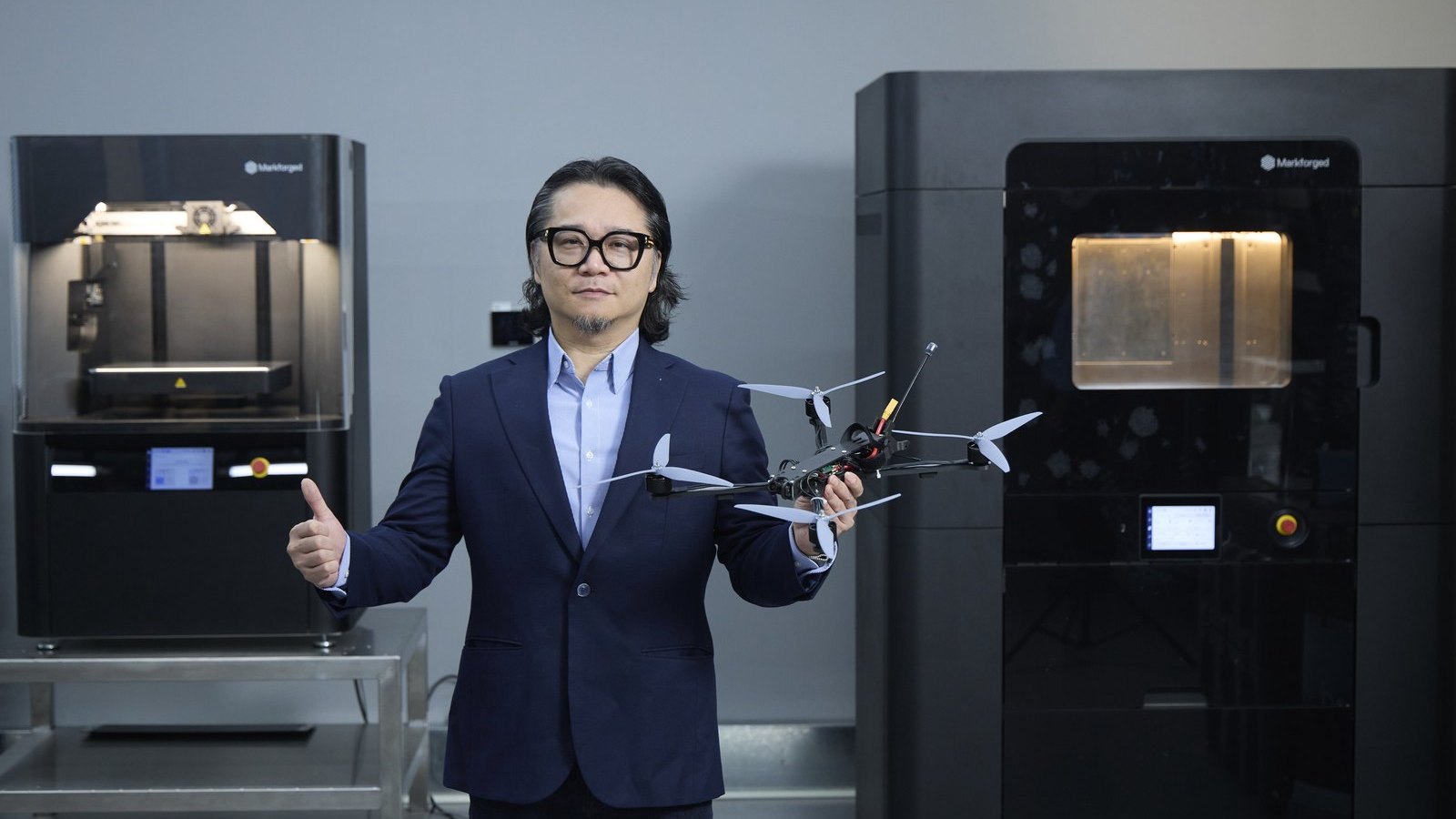
Below are the key points of the talk in slide order, each with its slide. The talk video comes in Chinese and English, with two official Markforged videos played in full inside; the slides are available to download at the end of the page.

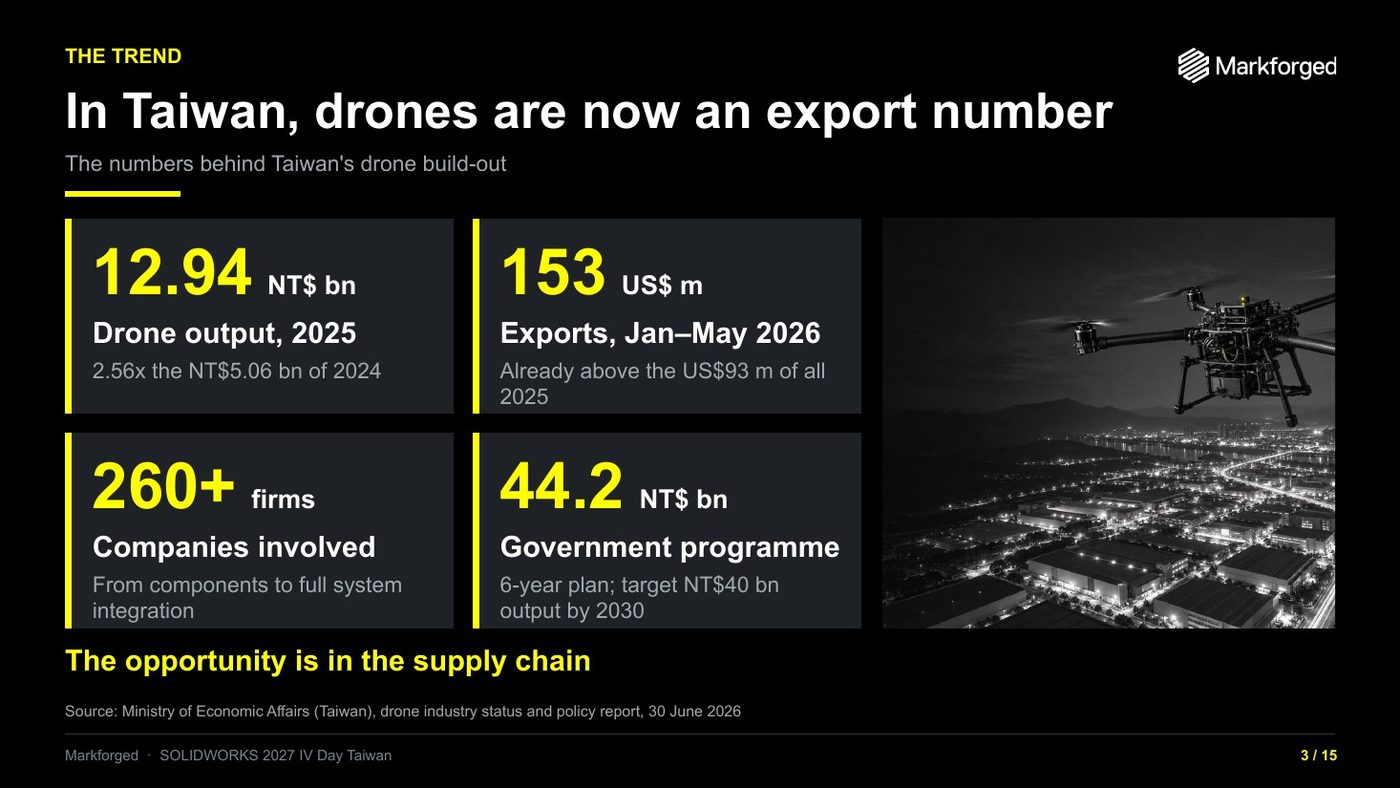
In Taiwan, drones are now an export number
The opportunity is in the supply chain: verified, scalable, reliable delivery
Taiwan's drone output reached NT$12.9 billion in 2025, 2.56 times the year before; exports in the first five months of 2026 reached US$153 million, already more than all of 2025. More than 260 companies are involved, from components to full system integration, and the government's six-year programme is NT$44.2 billion, targeting NT$40 billion in output by 2030. Customers want suppliers who can verify, scale and keep delivering.
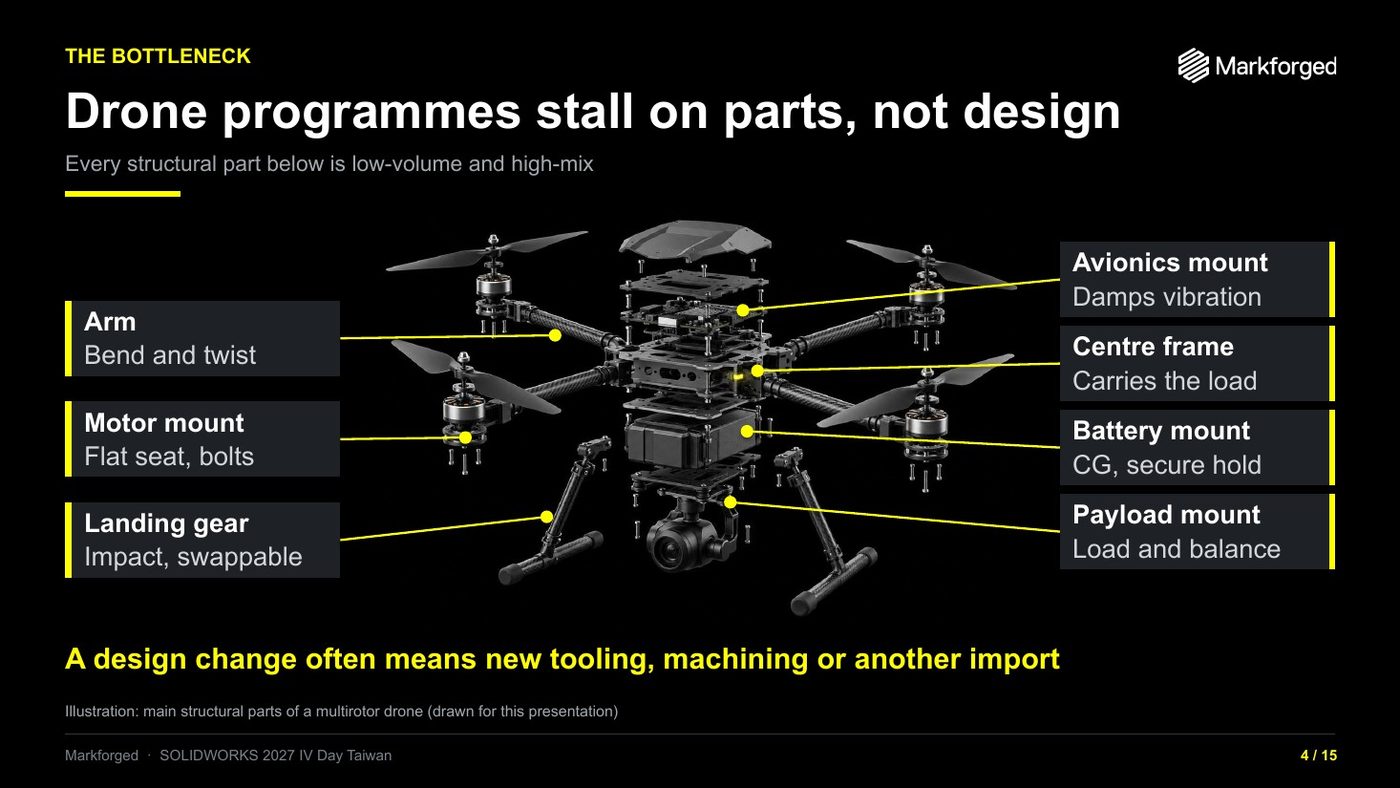
Programmes stall on parts, not design
Iteration speed sets the speed of the whole programme
Arms, motor mounts, landing gear, the avionics mount, centre frame, battery mount and payload mount are all low-volume and high-mix. Every design change often means new tooling, more machining or another import, and then you wait.
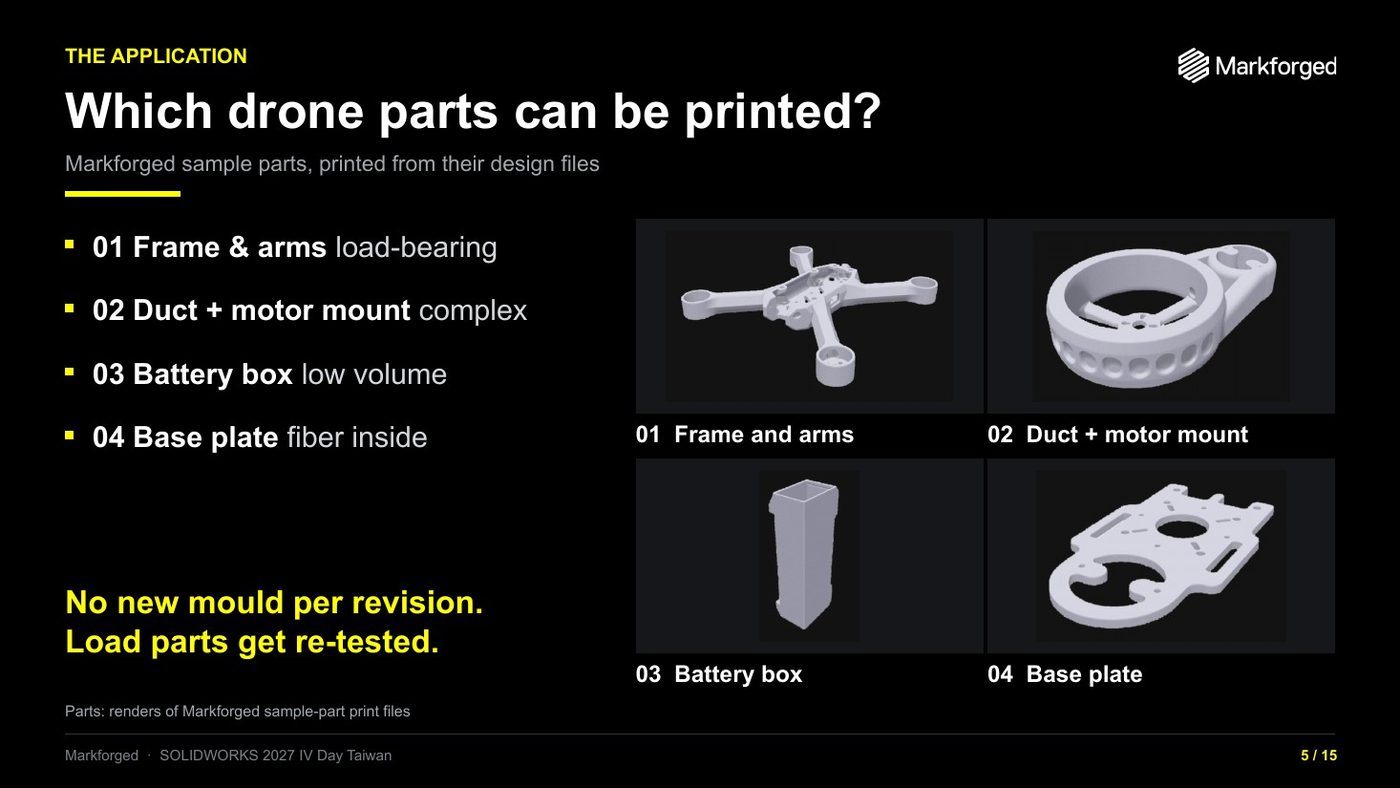
Which parts can be printed directly
No new tooling for every revision: change the design, print, then test the load-bearing parts
A frame with arms, a duct guard with the motor mount at its centre, a battery box, and a base plate with continuous carbon fiber inside: all are print files of Markforged sample parts. Landing gear and the jigs and fixtures on a production line can be printed too.
Continuous fiber: the biggest difference
You choose the layers and regions that get fiber
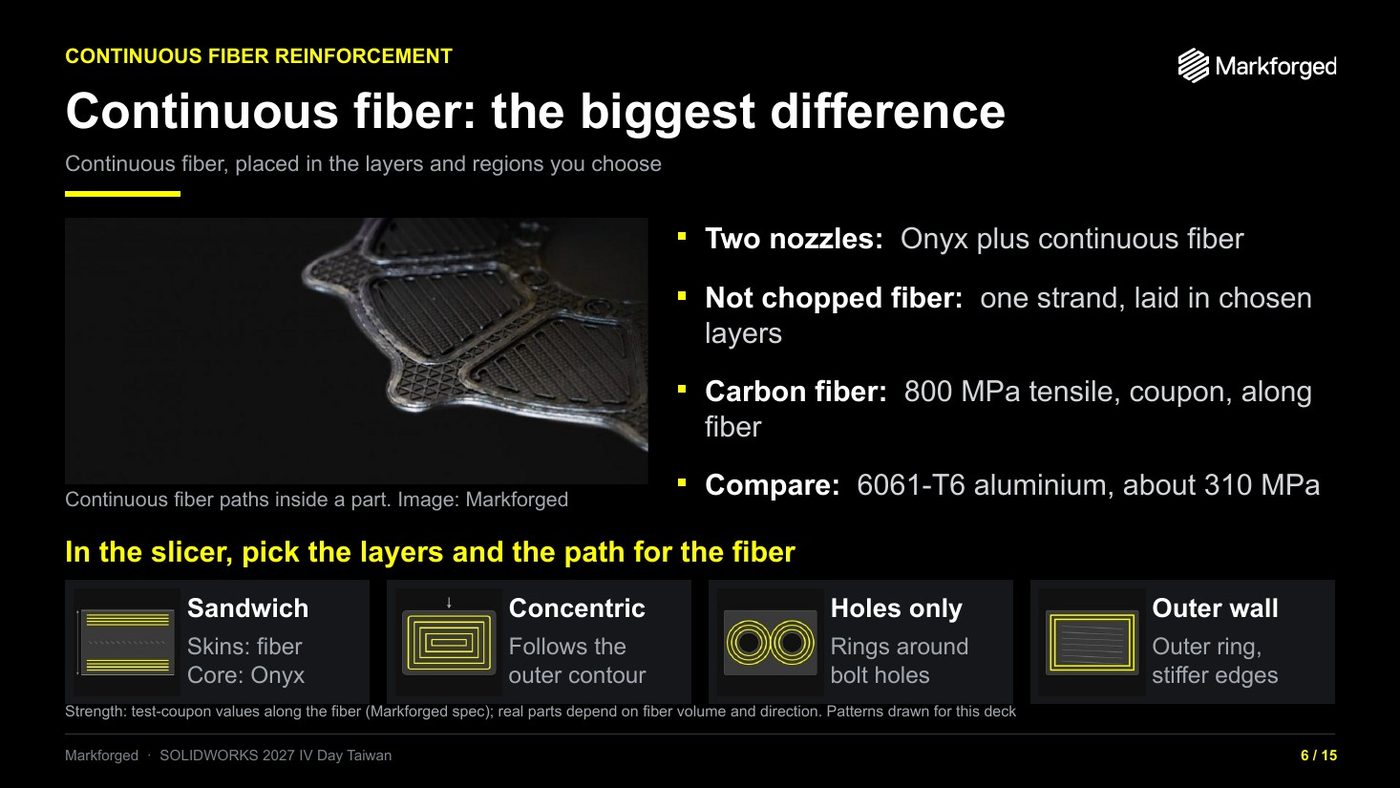
The printer has two nozzles: one extrudes Onyx, a nylon filled with micro carbon fiber, for the shape; the other lays a single continuous strand of carbon fiber inside the part. Along the fiber, a continuous carbon fiber test coupon reaches 800 MPa in tension, against about 310 MPa for 6061-T6 aluminium; these are coupon values, and a real part depends on how much fiber is laid and in which direction. Sandwich, concentric, holes-only and outer-wall patterns are chosen layer by layer in the slicer.
Strength is easiest to see
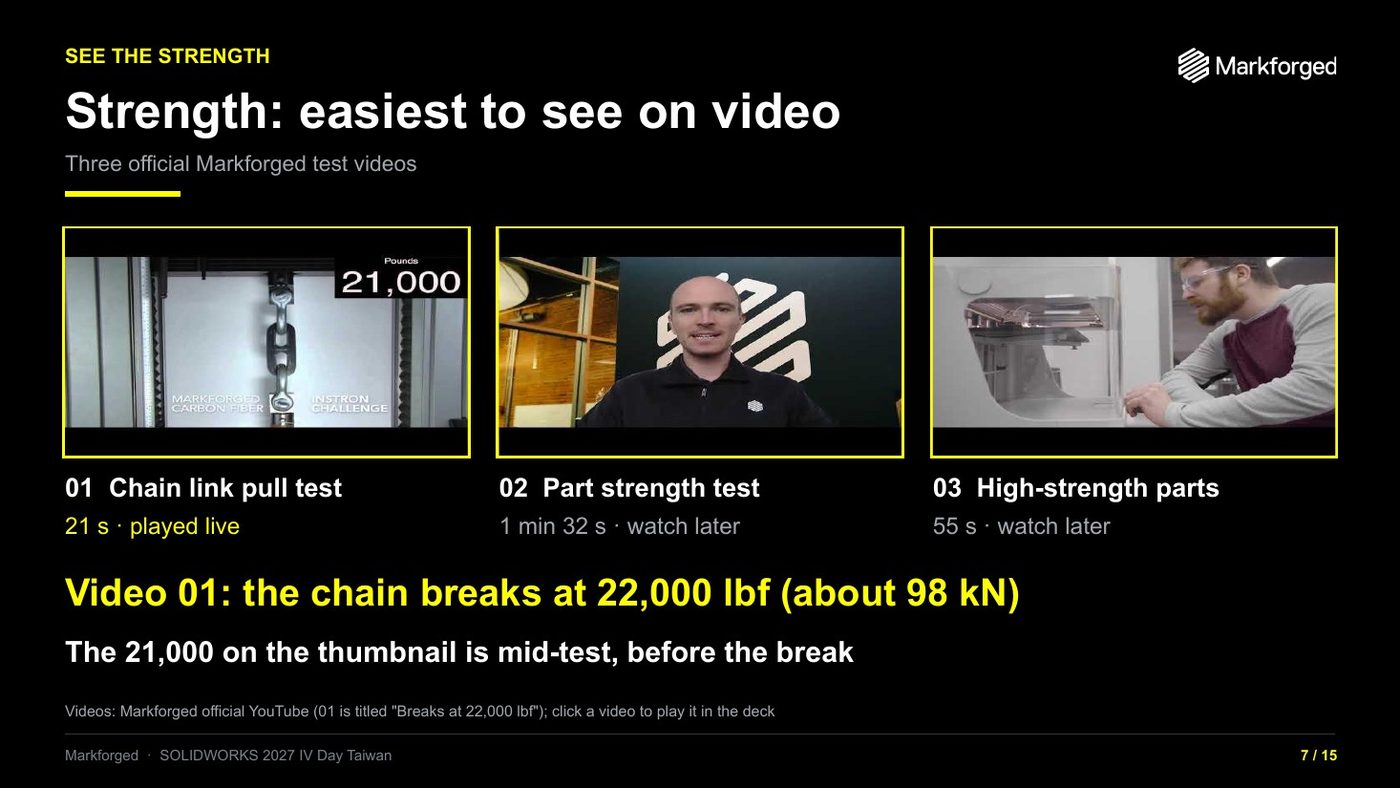
A continuous carbon fiber chain link breaks at 22,000 lbf
That is about the pull of a ten-tonne weight. The video plays Markforged's official chain-link pull test in full.
From composites to metal: three equipment lines
FX10, FX20 and X7
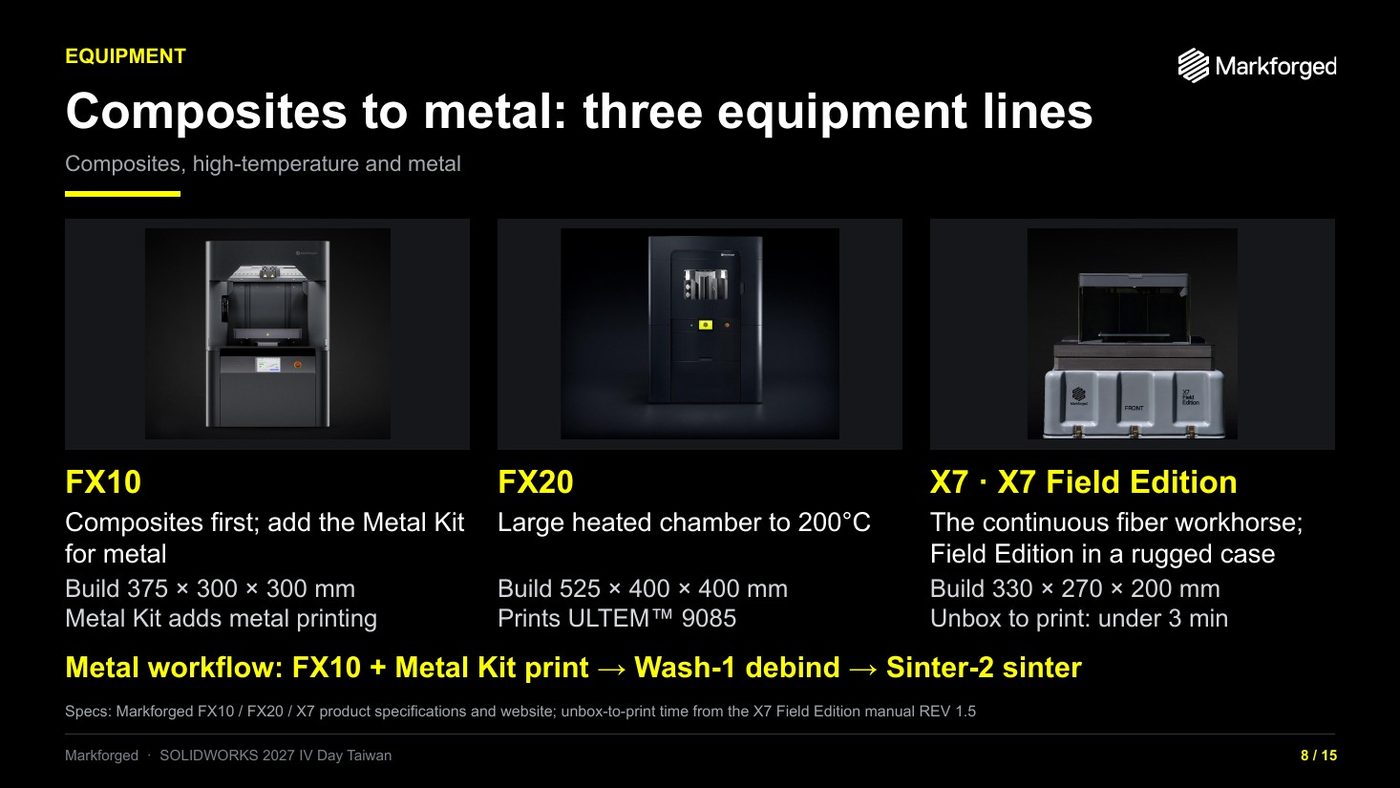
FX10 starts with composites; add the Metal Kit and it prints metal, with Wash-1 debinding and Sinter-2 sintering completing the metal workflow. FX20 is the large-format machine, with a heated chamber up to 200°C, and prints ULTEM 9085. X7 is the continuous fiber workhorse; the X7 Field Edition ships in a rugged transit case and goes from unboxing to printing in under three minutes.
Drone makers worldwide already do this
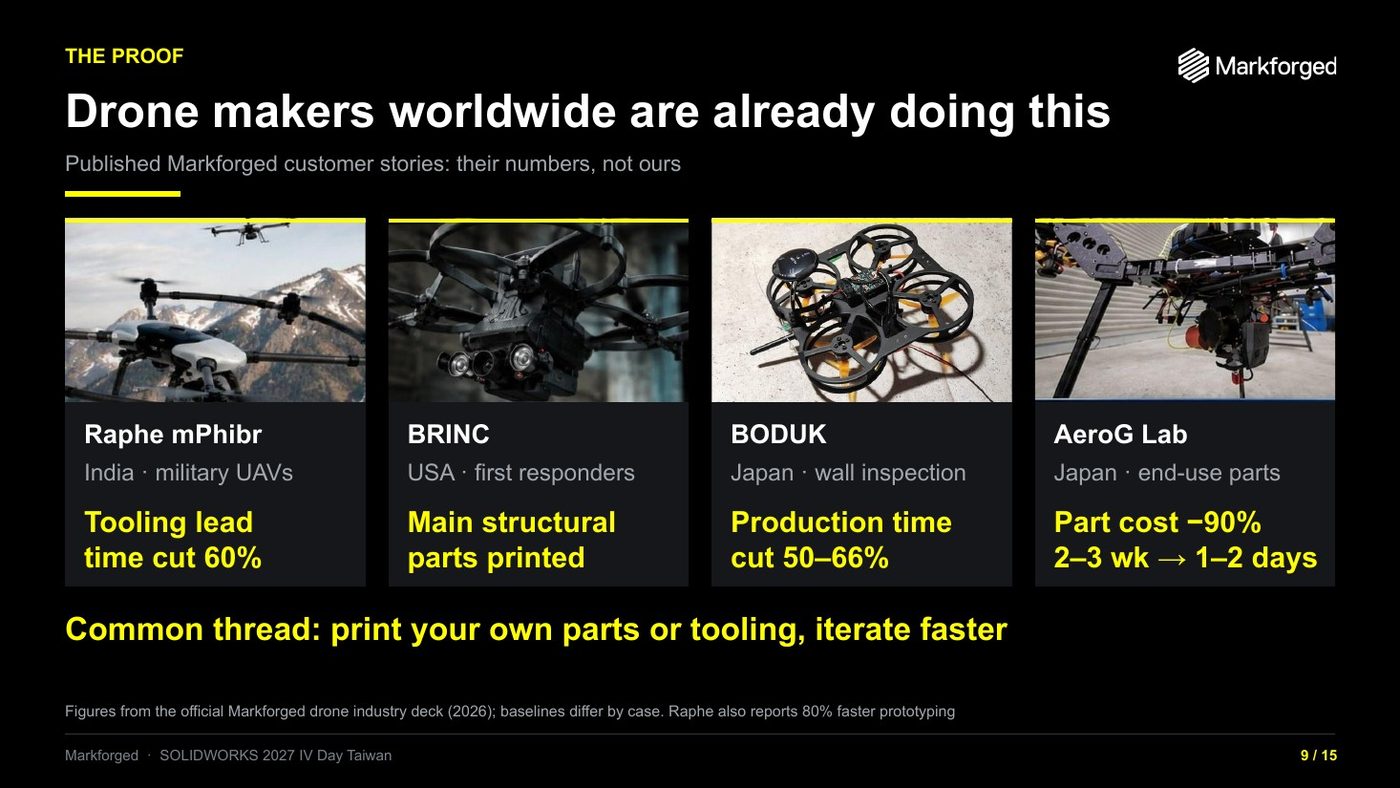
These are their own published numbers
Raphe mPhibr in India cut tooling lead time by 60%; BRINC in the US prints the main structural parts of its first-responder drones; BODUK in Japan cut production time for its wall-climbing inspection drones by 50–66%; AeroG Lab in Japan cut part cost by 90% and lead time from two or three weeks to one or two days. Gamma Rotors in India grew from one printer to more than ten, and the video plays them telling it in their own words.
Taiwan case: ASTER-SWARM
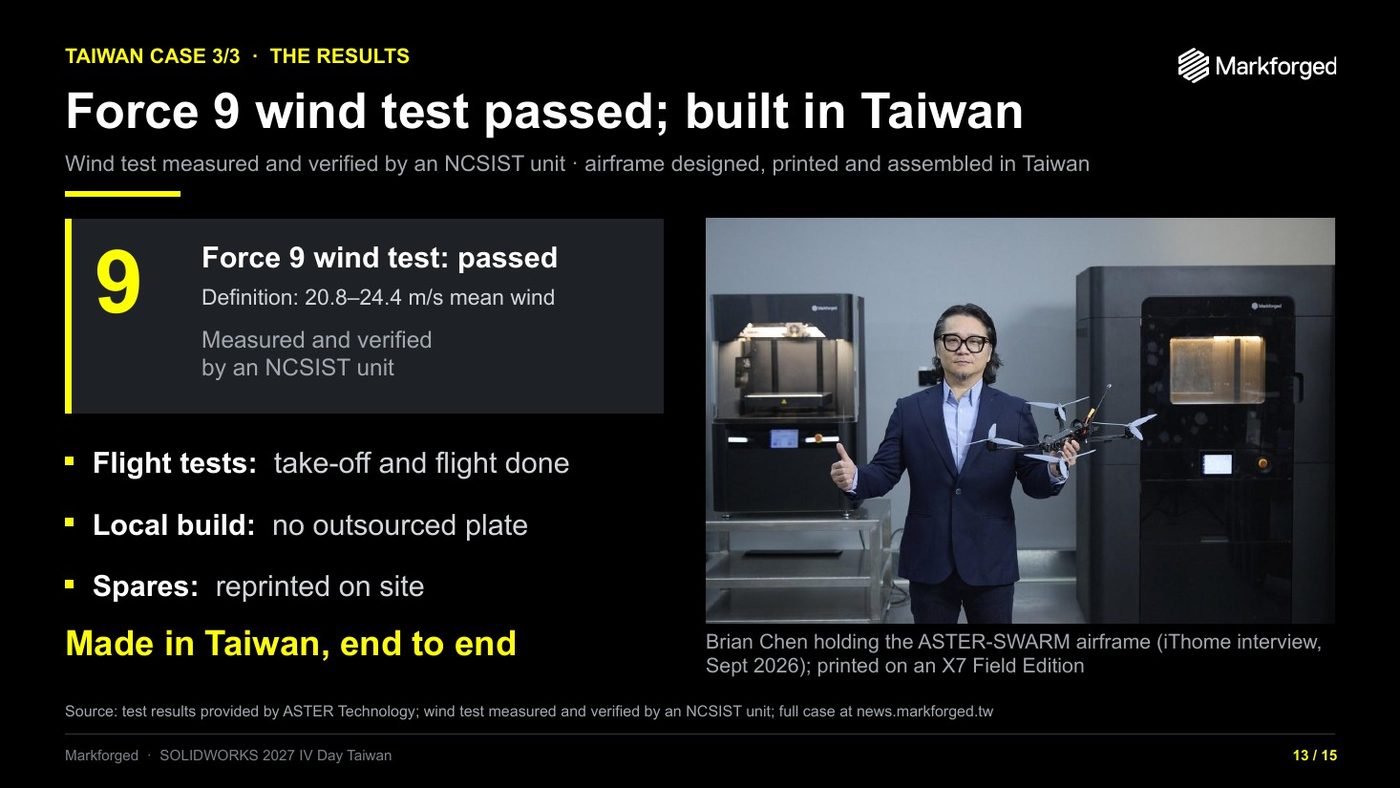
Force 9 wind test passed; designed, printed and assembled in Taiwan
An FPV drone goes to full throttle, turns hard and dives within seconds. Frames printed in ordinary filament tend to flex at the arms, resonate, crack along layer lines and deform around the motor mounts as they heat up. The alternative, CNC carbon plate, is strong enough, but every design change means a new cut and another wait.
ASTER Technology printed the airframe on the X7 Field Edition, with continuous carbon fiber concentrated at the arm roots and motor mounts and the airframe split into five standard modules. The prototype passed a Beaufort force 9 wind test, measured and verified by a unit of NCSIST. Full case →
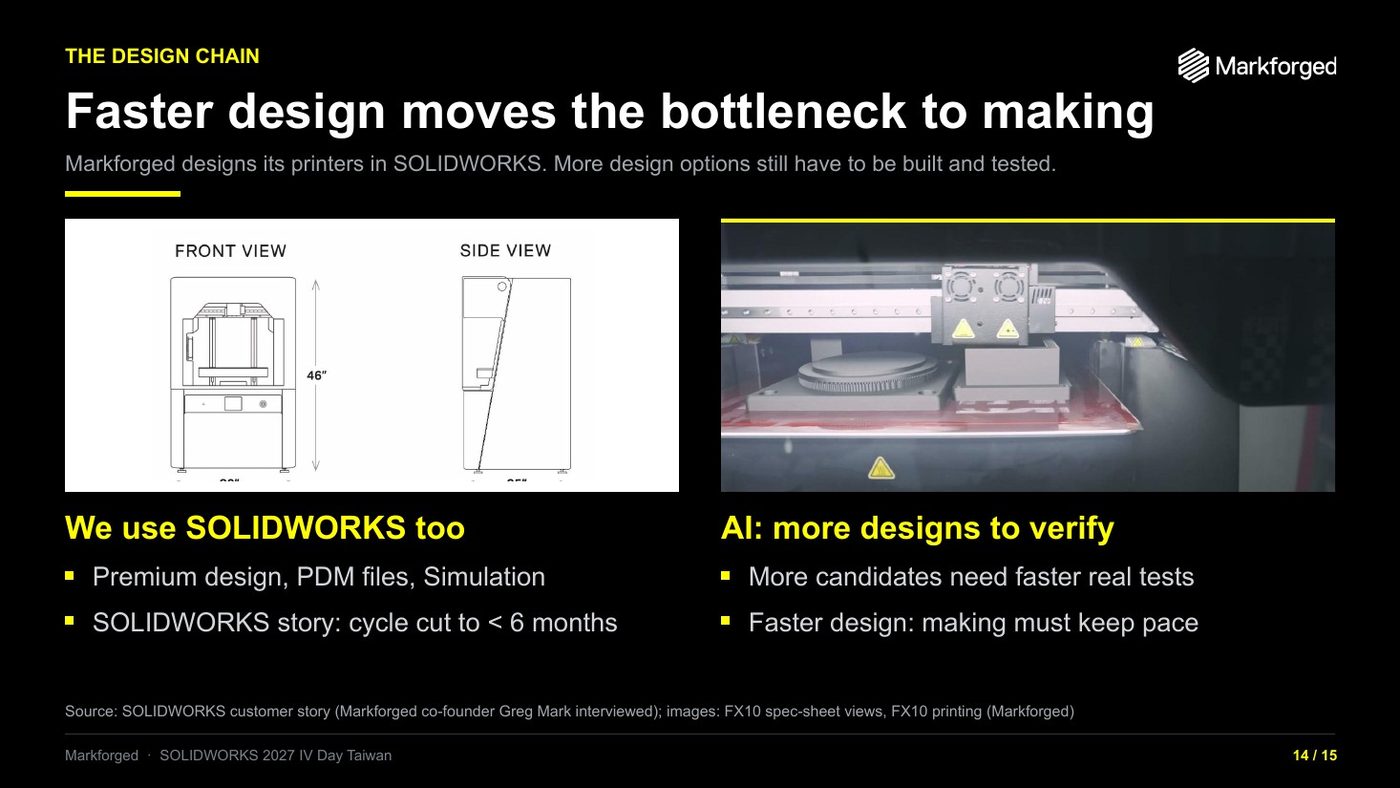
Faster design moves the bottleneck to manufacturing
Markforged designs its own printers in SOLIDWORKS
Premium for design, PDM for files and Simulation for analysis cut the new-product development cycle to under six months at the time. AI will multiply candidate designs, with generative design and topology optimisation producing several versions at once; but the key design still has to be built, fitted and flown. When design speeds up, manufacturing has to keep the same pace.
Bring a part, and let us assess it
Bring a drawing or a non-confidential STL file, and tell us the use, loads, temperature and quantity. We will assess whether it can be printed, in which material and how long it takes; if machining or tooling is the better deal, we will say so.
Contact usSources
- Taiwan drone industry figures: Ministry of Economic Affairs (Taiwan), Aerospace Industry Development Office, status of Taiwan's drone industry and policy priorities, 30 June 2026.
- Global case figures are from Markforged's official drone industry deck (2026); baselines differ by case, and each figure applies to that case's conditions.
- The chain-link pull test and Gamma Rotors footage are from Markforged's official YouTube channel.
- ASTER-SWARM test results were provided by ASTER Technology; the wind test was measured and verified by a unit of NCSIST. The header photo is from an iThome interview in September 2026.
- The video was produced by Markforged Greater China from the talk's slides; the narration was synthesised from Brian Chen's own voice. The drone backgrounds are illustrations, not Markforged products or any customer's aircraft; product imagery is official Markforged material.
Back to the Media Hub · markforged.tw