
Greater China
Has Three Layers
Close to one hundred thousand aircraft. That is Taiwan's drone order book once you add the 2026 military procurement to the 2026–2028 civilian government programme. Defence spending stands at NT$949.5 billion, about 3.32% of GDP, a record. And the conversation has converged on one question: who qualifies for the non-China supply chain.
Clearing an origin audit is not supply-chain security.
It is the first layer of three.
HISTORY · WE HAVE RUN THIS PLAY BEFORE
You can relocate assembly. You cannot relocate the upstream.
You do not need three years to judge whether a supply-chain shift worked. Semiconductors already ran the full cycle, and the result is sitting there as a control group.
Taiwan is second in the world by semiconductor output and first in both fabrication and packaging-and-test. Advanced nodes and forward R&D stayed on the island; roughly ninety percent of local firms' footprint is domestic. On the question of who manufactures, Taiwan won.
But the same industry review carries another line: self-sufficiency in semiconductor equipment and materials remains inadequate. The hardest layer to replace is still there, two decades on. The supply chain has since been asked to go "Taiwan plus one" — relocating assembly again, not the upstream dependency.
Batteries are the second control group. As the US pushed de-risking, Taiwanese materials suppliers won orders, and batteries were reclassified from an industrial contest into a national-security specification. What determines the long-term position is still not who assembles, but who holds the materials and the equipment.
Drones now stand exactly where semiconductors once stood. Switching suppliers is the visible, countable, newsworthy step. The hard layer rarely appears on a bill of materials.
FRAMEWORK · THE THREE LAYERS
Three layers, and they are sequential
Break it apart and it gets much clearer. Supply-chain security is not a yes-or-no question. It is a three-layer structure, and the layers build on each other.
These are not parallel options. Clearing layer one is a pass mark, nothing more. Skip layer two and everything you achieved in layer one leaks out the back door. Skip layer three and the first two get traded away under delivery pressure — when the part a customer needs is two weeks out, everyone starts looking for shortcuts.
Virtually the entire public conversation today sits in layer one.
LAYER 2 · DATA SOVEREIGNTY
The components are compliant. What about the files?
Once manufacturing goes digital, part geometry, material parameters, process records and inspection reports all become files. Whose servers hold them, which jurisdiction they sit in, and who can pull them — that is the second layer, and it is almost absent from the current debate.
This is not a hypothetical. Most additive manufacturing platforms default to cloud-side slicing and project management. For general manufacturing that is fine, and frankly more efficient. For defence research institutions it is a threshold they cannot cross — not because the process is inconvenient, but because the regulations do not permit it.
That single point decides who gets in. Our way into high-security environments is not a specification sheet. It is on-premise deployment, no cloud, role-based access control. That is the only configuration those environments accept. Building the argument on part-level traceability maps directly onto their existing quality documentation, so nobody has to rewrite a QA system to adopt a new process.
One practical detail is worth stating plainly: traceability and cloud are not inherently coupled. Material data, process parameters and inspection reports travelling with the part — so that design, process and QA judge a part against one dataset — works just as well on-premise. Binding the two together is a platform's commercial choice, not a technical necessity.
- Slicing runs on the vendor's cloud
- Projects and part library stored off-site
- Geometry files leave the local jurisdiction
- Access rights defined by the platform
- Compute and data stay inside the facility
- Role-based access controlled by the institution
- Part-level traceability fully retained
- Maps onto existing QA documentation
LAYER 3 · CAPACITY SOVEREIGNTY
Delivery pressure is what makes you trade away the first two
The third layer is the one most often mistaken for a pure efficiency question. It is actually the fuse protecting the other two.
A hundred thousand aircraft is not one order and one delivery. It is batched over three years, and the specification will change. A drone is not a product; it is a platform that changes every quarter. The publicly stated approach in the sector is modular design plus additive manufacturing, precisely to reduce dependence on conventional moulds and complex tooling.
The flip side of modularity is that the tooling changes with it. What actually stalls an assembly line is rarely a missing machine. It is the locating fixture, the soft jaw, the poka-yoke plate that has not been made yet. None of these need part-level precision, yet they compete for the same CNC queue as the parts themselves.
There is a specification that gets conflated here constantly. Take ±0.02 mm: that is a requirement on the machined face of the part, not on the fixture body. Bushings and inserts exist for wear and clamping, not to compensate for tolerance. Tying fixture precision to part precision is one of the root causes of a saturated CNC schedule.
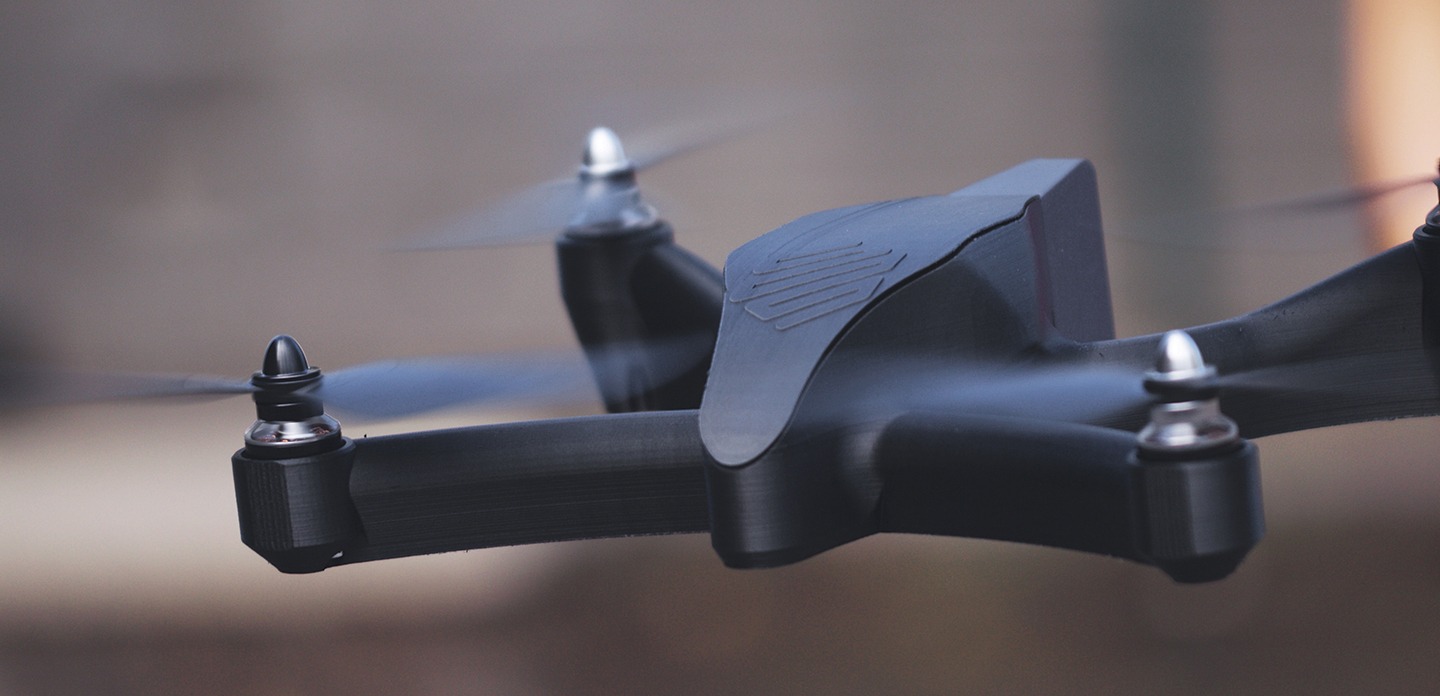
Take one UAV airframe printed in continuous carbon fibre, with arms, centre plate and battery bay as a single continuous-fibre structure. It passed wind-tunnel testing to Beaufort force 9, printed on an X7 Field Edition — ruggedised, deployable, no cloud dependency.
Lay out the exploded view and the interesting thing is not the printed parts. It is the parts that disappeared. A structure that previously required separate fabrication and fixture-located assembly is now formed in one piece. Every part removed takes its fixture, its assembly hours and its tolerance stack with it. That programme was pulled a full year forward — not by working faster, but by turning "a design change takes two weeks" into "a design change takes overnight".

CONCLUSION
Start by drawing the map
You do not need an equipment conversation first. Do one thing this month: draw your manufacturing data flow as a diagram. Geometry files, material parameters, process records, inspection reports — whose servers hold each one, which jurisdiction it sits in, and who can retrieve it.
If you cannot draw that diagram, your supply-chain security stops at layer one.
Audit all three layers once
A three-layer audit is not a procurement process. It is an engineering reconciliation: component origin, data flow, and how much CNC time your critical fixtures actually consume. The Markforged Taiwan Centre of Excellence and the Greater China team can run it with you — starting from your line's real numbers, not from an equipment specification.
- Manufacturing data-flow audit: which files have left your jurisdiction
- Critical fixture queue audit: how many CNC hours they consume
- On-premise deployment configuration for defence and high-security environments