
News & Insights
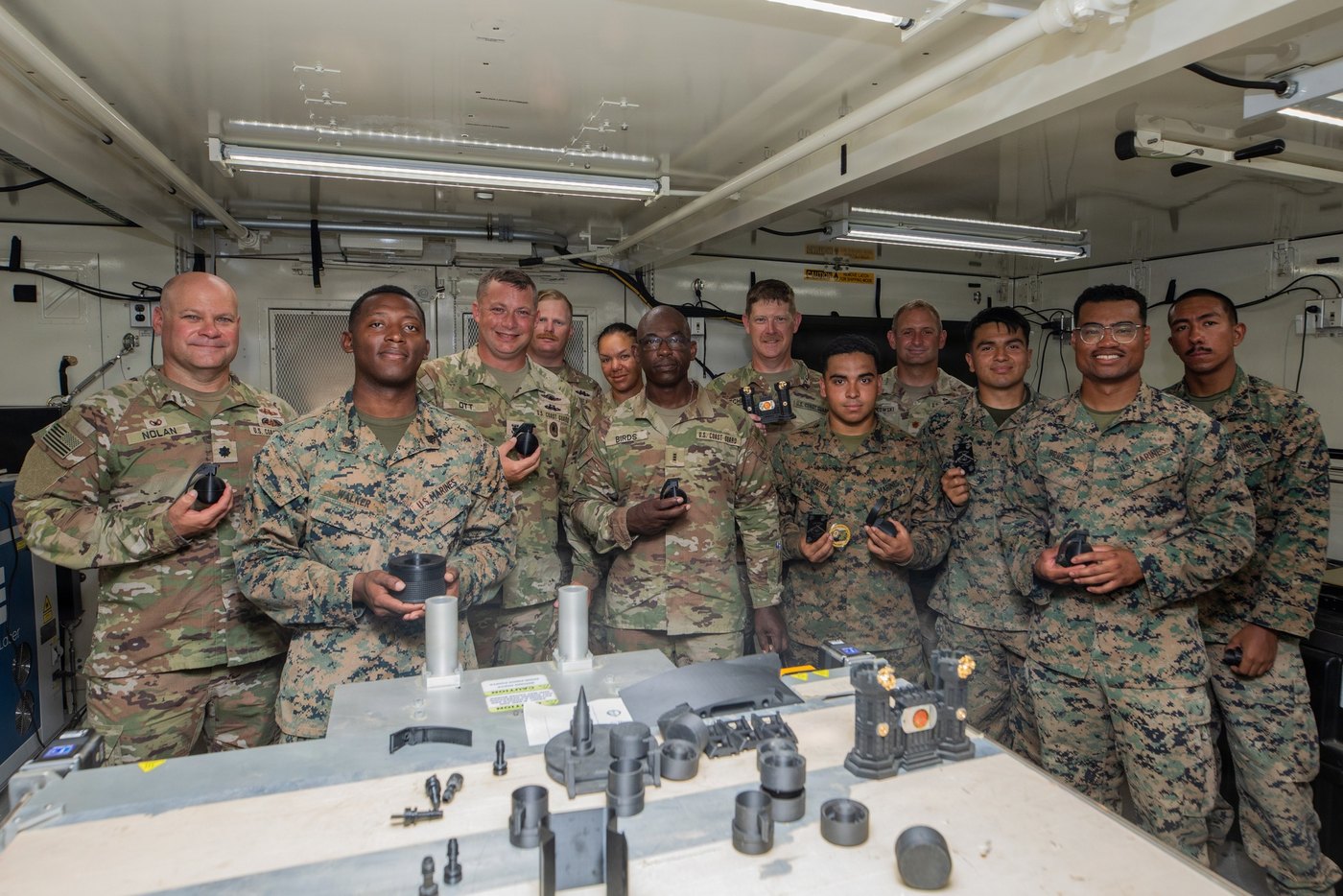
and a resupply cut from weeks to hours
Marines with 3rd Maintenance Battalion, 3rd Marine Logistics Group, reverse-engineered the strainer inside an Expeditionary Fabrication Facility (X-FAB), adjusted the design and 3D printed it in under half a day, at about $12 per part — the same as the original. The story was released by the US military on DVIDS in July 2026.
“In this case, we cut a potential two- to three-week shipping delay for a replacement part down to just a few hours.”
Chief Warrant Officer 2 Jonathan B. Salas · Utilities Officer, Regional Maintenance Operations Company North, 3rd Maintenance Battalion (DVIDS)The problem
One part, one boat out of action
RHIBs carry the Coast Guard’s quick-reaction and patrol missions in the exercise area, and each is valued at around $600,000. When a small part like a strainer is out of stock, the whole boat waits on resupply.
Salas described a demand to reduce supply deficiencies and backorders so repairs can move faster: “Advanced manufacturing is one answer to solve this problem set.”
The fix
Under half a day, first time right
Inside the X-FAB, the team reverse-engineered the original strainer, modified the design, printed it and fitted it back on the boat for testing.
“The first prototype was a success; they were taken aback by the fact that a part such as their strainer can be reverse-engineered and 3D-printed in full in less than half a day.”
Cpl. Kenzie Gallang · Metal worker, 3rd Maintenance Battalion (DVIDS)Salas said the replacement part cost about $12 to print, the same as the original, and that a cheaper filament could cut another $4 without sacrificing performance.
X-FAB
A small factory taken to the field
X-FAB, the Expeditionary Fabrication Facility, is a self-contained fabrication lab the Marine Corps began evaluating in 2017: a 20-by-20-foot shelter that, at evaluation, held four 3D printers, CAD software and a 3D scanner, and that four Marines could set up on site in two to three hours.
3D Printing Industry reports that the X-FAB system includes Markforged Mark Two printers. The military’s public reports do not say which machine printed this strainer.
Why it matters
Building the part where it is needed
Col. Robert Fairley, commanding officer of Combat Logistics Regiment 35, said the unit is demonstrating that nontraditional manufacturing methods, even in an expeditionary environment, can produce parts that matter to the mission.
Salas added that the printed part kept the Coast Guard’s boats in use for quick-reaction-force and patrol missions, securing the waters around CJLOTS.
Precedent
Markforged at sea and in the field
Shipboard and forward environments are an established setting for Markforged industrial printers. In February 2023, NAVSEA announced that the Virginia-class attack submarine USS New Hampshire (SSN 778) had installed a Markforged X7 Field Edition in July 2022 for repairs such as pipe leaks and electrical enclosures; NAVSEA chose the X7 for its ability to remain reliable in a simulated shipboard environment.
The X7 Field Edition is the ruggedized, deployable version of the X7 industrial continuous-fiber platform — see the product page.
Defense and point-of-need assessment
Markforged engineers can assess feasibility on your actual parts and operating environment and arrange a demonstration in Taiwan, China, Hong Kong or Vietnam.
Contact usSources
- DVIDS: Advanced manufacturing supports joint and bilateral readiness at CJLOTS 26 in South Korea (25 July 2026); figures and quotes in this article are from this release
https://www.dvidshub.net/news/570729/advanced-manufacturing-supports-joint-and-bilateral-readiness-cjlots-26-south-korea - VoxelMatters: Marines 3D print Coast Guard boat part in hours during Korea exercise (27 July 2026)
https://www.voxelmatters.com/marines-3d-print-coast-guard-boat-part-in-hours-during-korea-exercise/ - 3D Printing Industry: Marine Corps X-FAB Saves Coast Guard Patrol Boats (31 July 2026); X-FAB description and configuration
https://3dprintingindustry.com/news/marine-corps-x-fab-saves-coast-guard-patrol-boats-253447/ - NAVSEA: New additive manufacturing printer enables sailors to think outside the box (24 February 2023)
https://www.navsea.navy.mil/Media/News/Article/3309929/new-additive-manufacturing-printer-enables-sailors-to-think-outside-the-box - Hero image: Marines with 3rd Maintenance Battalion, Combat Logistics Regiment 35, and Coast Guardsmen with Port Security Unit 309 after a 3D printing showcase in Pohang, South Korea, 17 July 2026. Photo: Lance Cpl. Marcus Henson / US Marine Corps, released to the public domain via DVIDS
Compiled by the Markforged Greater China & Vietnam team.
Back to the Media Hub · www.markforged.tw