
News & Insights
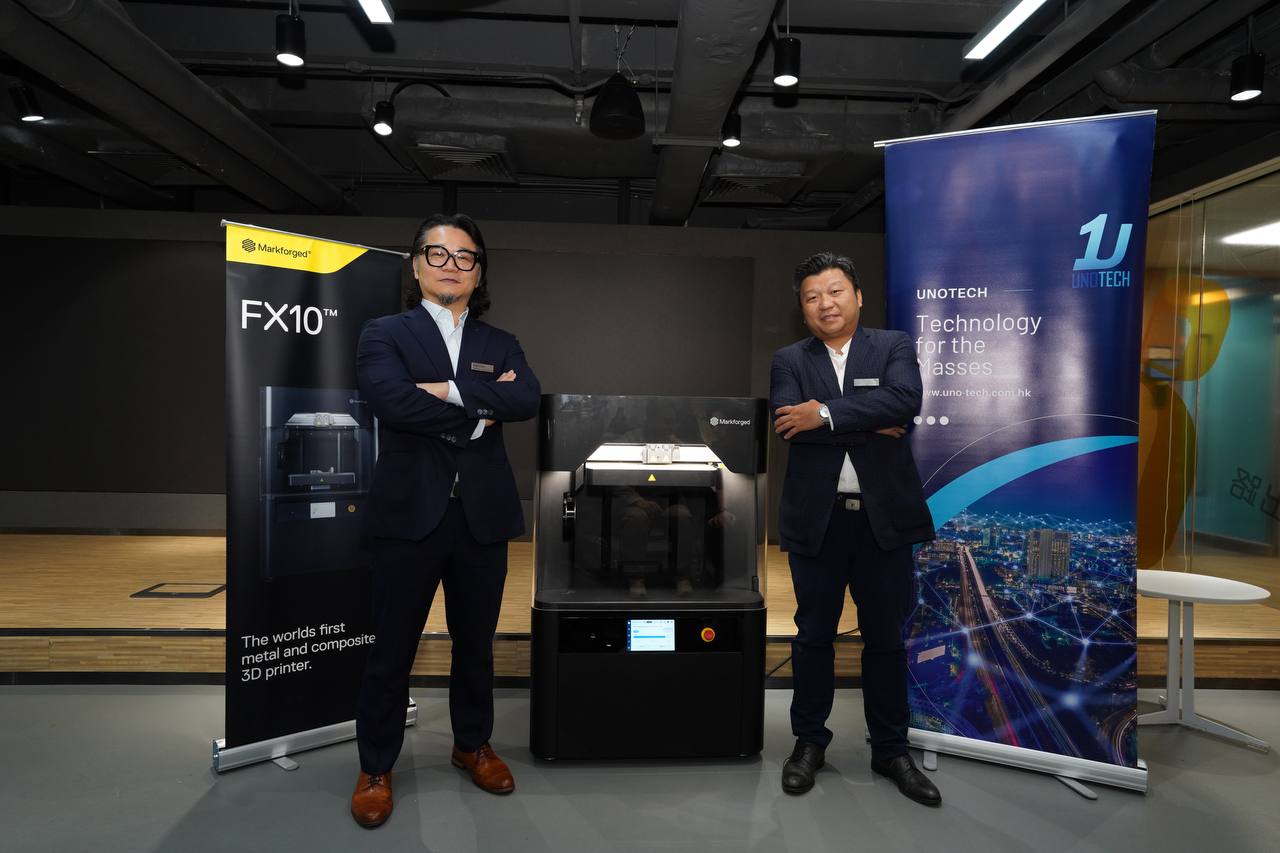
“Hong Kong is a technology and trading hub for the Greater Bay Area, with a customer base spanning multiple high-end manufacturing sectors. We chose Unotech as our exclusive partner for its depth of local technical capability and the strength of its after-sales coverage.”
Brian Chen | Country Manager, Greater China and Vietnam, MarkforgedContinuous Fiber Reinforcement
Continuous fiber, not chopped fiber
The technical session centred on Continuous Fiber Reinforcement (CFR). During the build, continuous strands of carbon fiber, Kevlar or high-strength high-temperature glass fiber are laid inside the part, bringing strength and stiffness close to machined metal. Parts go straight into fixtures, robotic grippers, line tooling and functional end-use applications.
Material figures cited at the event: Onyx reinforced with continuous carbon fiber reaches 800 MPa tensile strength. For comparison, 6061-T6 aluminium, a common structural alloy, is 308 MPa, and general-purpose ABS around 30 MPa. A tensile test film shown on the day recorded a reinforced part breaking at 22,200 lbf — roughly 10 tonnes.
Beyond composites, Markforged's metal additive process runs in three stages: print, wash, sinter. A filament of metal powder and binder is printed into a green part, solvent washing removes the first-stage binder, and a furnace densifies the part. Unlike metal 3D printing systems that rely on loose powder, this route never requires handling loose metal powder. A ceramic release layer is printed automatically between the part and its supports; after sintering it remains powdered, which makes separation easy and helps control shrinkage and dimensional accuracy. Shrinkage is compensated automatically by the cloud software according to the selected material, so users do not scale models by hand or work it out by trial and error.
Live demonstration
Engineers decide on numbers, not on being told a part is strong
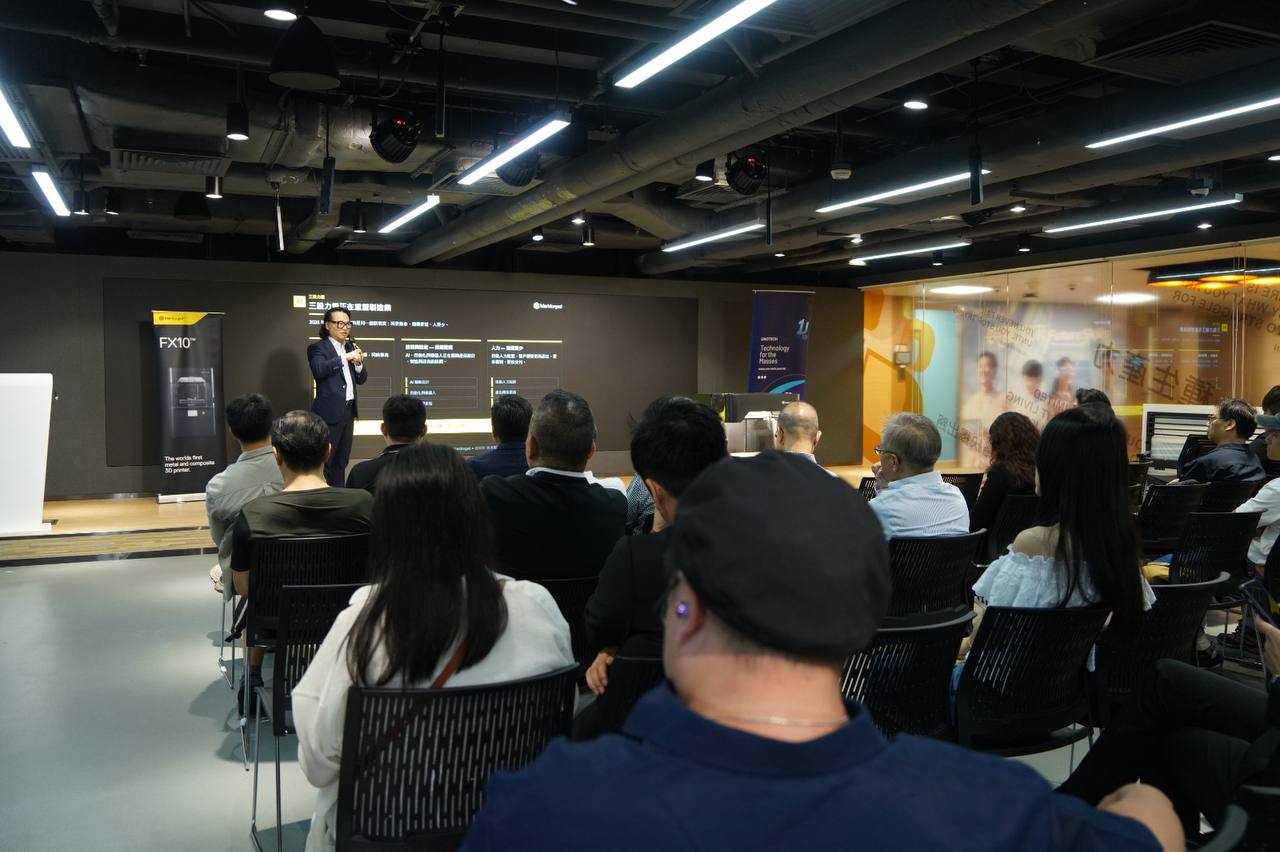
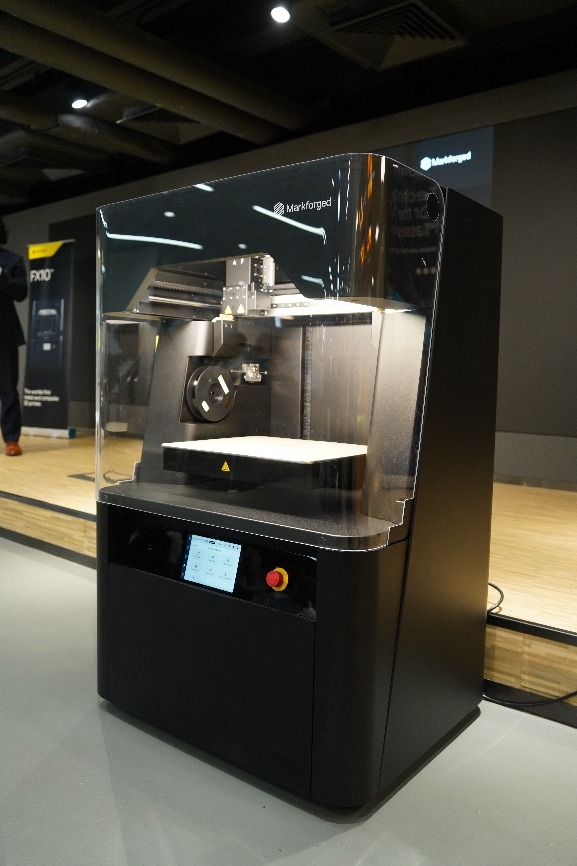
Unotech's system engineers demonstrated the FX10 live, printing two samples in Onyx — one reinforced with continuous carbon fiber, one without — so the audience could compare them directly.
The same session covered Eiger, the cloud slicing and print management platform. Once an STL is uploaded, Eiger reports part dimensions, estimated print time, finished weight, material consumption and cost. Users adjust layer height, infill and fiber routing, and preview the slice layer by layer. An offline version is available for production environments without network access. The point returned during Q&A, when an attendee asked how to estimate return on investment: the costing is produced at upload, not in a separate spreadsheet.
Customer case: PolyU
A saddle printed in one piece: comfort is not the first priority, safety is
A research team from PolyU's School of Fashion and Textiles presented a bicycle saddle developed with Markforged continuous fiber technology. The design was recognised with a Red Dot Award (Design Concept) in 2024 and holds an invention patent.
The concept came from spacer fabric, the sandwich-structured textile used in athletic shoe uppers, which compresses under load and springs back when released. The team translated it into an S-shaped cushioning structure inside the saddle, with continuous carbon fiber carrying the structural load. That allowed the whole saddle to be printed in one piece, without the metal rails and multi-material assembly of a commercial product. C-shaped perforations on the surface improve ventilation. The finished saddle weighs about 190 grams.
For validation the team built an artificial buttock form with a carbon fiber skeleton under a silicone skin, applying a 250 kg load ten times with a ten-second hold; the saddle returned to shape after unloading. A team member also ran long-term rider testing, accumulating more than 1,500 km over nearly two years without failure. The five-person team worked across faculties with the university's Industrial Centre and its 3D printing research facility (U3DP).
As the team put it, comfort is not necessarily the first priority for a bicycle saddle — safety is. That is exactly why continuous carbon fiber was chosen: it carries the structural load while keeping the part light.
Market context
When the orders arrive, the bottleneck is not the machines — it is the parts out for subcontract
Local manufacturers and engineering units face two pressures at once: compressed lead times, and a rising share of small-batch, multi-specification orders. Tooling takes the brunt — fixtures, jigs, gauges and robotic grippers. These are usually one-offs or very small batches whose specifications change with each product revision, and outsourced machining is quoted in weeks.
Additive manufacturing moves that segment back inside the plant: revise the design and print again, with no new tooling and no queue at an outside shop. Parts can also be held as digital files and printed on demand, replacing physical spares inventory. For Hong Kong — limited floor space, high labour cost, tight delivery requirements — the difference is pronounced.
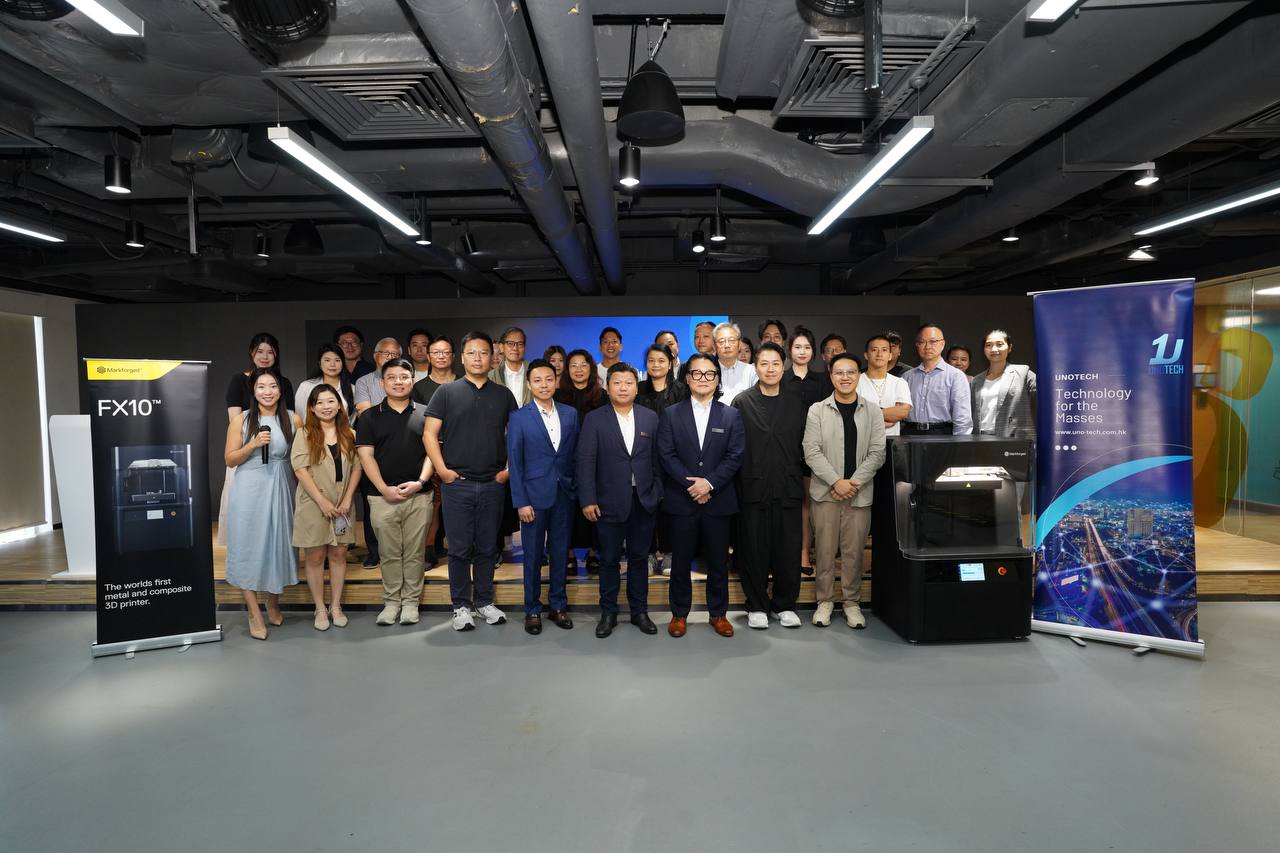
Unotech has already installed demonstration equipment and completed staff training, targeting aviation MRO, electronics manufacturing, medical devices and precision engineering. The adoption path set out at the event: the customer identifies the part with the longest lead time and highest cost, signs an NDA, and hands it to Unotech for assessment. The part is digitised, printed, and validated in the customer's own line.
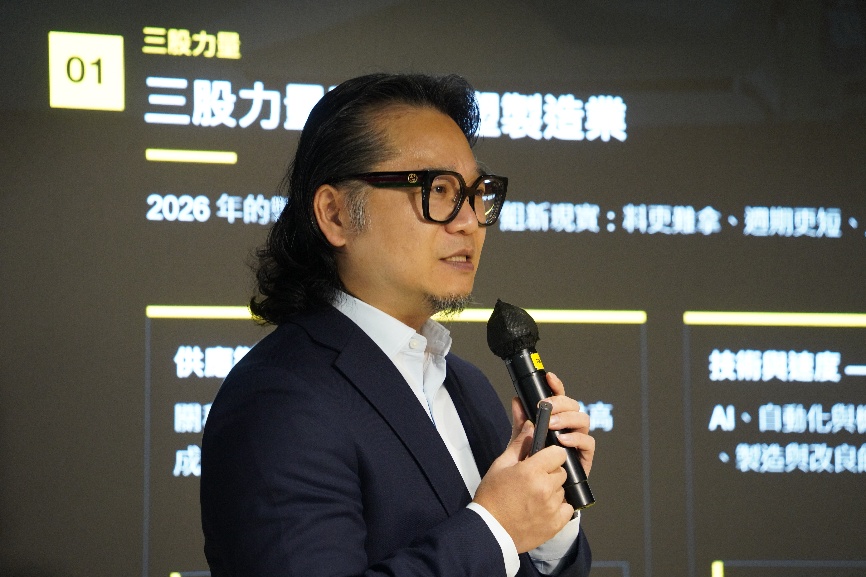
“We are honoured to enter an exclusive partnership with Markforged, a leading brand in industrial 3D printing. With Markforged's technical strengths in additive manufacturing, we are confident we can bring Hong Kong more cost-effective, reliable and innovative manufacturing options. Our local technical team will focus on aviation MRO, electronics manufacturing, medical devices and precision engineering — sectors whose demands on strength and turnaround align closely with continuous fiber technology. We will keep building local technical capability to support the long-term development of smart manufacturing in Hong Kong.”
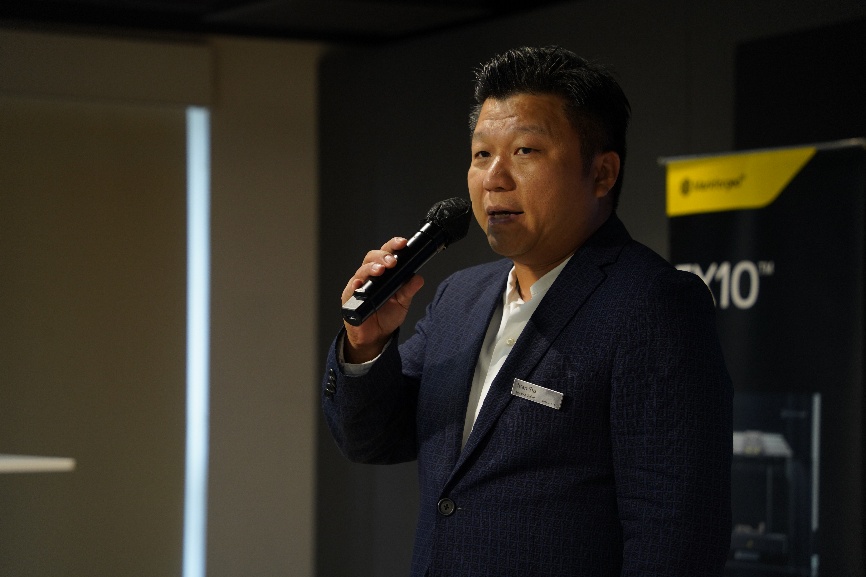
“Hong Kong is a technology and trading hub for the Greater Bay Area, with a customer base spanning multiple high-end manufacturing sectors. We chose Unotech as our exclusive partner for its depth of local technical capability and the strength of its after-sales coverage. An exclusive distributorship concentrates accountability: customers deal with a single point of contact and get end-to-end professional cover. The application cases and material validation data Markforged has built up across Greater China will feed directly into the Hong Kong team, helping local medical, aviation and precision engineering customers raise operating efficiency.”
About Markforged
Markforged is an industrial additive manufacturing company founded in 2013. Through the Digital Forge platform and Continuous Fiber Reinforcement (CFR), manufacturers produce high-strength end-use parts, tooling and spares at the point of production, shortening supply chains, reducing inventory and improving capacity resilience. Its product line covers industrial composite and metal additive manufacturing systems, used in aerospace, automotive, electronics, medical devices and precision engineering.
About Unotech Limited
Unotech Limited is a Hong Kong industrial technology solutions provider. It brings smart manufacturing and 3D printing technology to local research, education and manufacturing institutions, offering equipment supply, application development and technical support.
Point of contact in Hong Kong
Markforged's sales, technical support and application development in Hong Kong are now handled by Unotech Limited, whose local engineering team covers installation, training and application development. For a feasibility assessment on a specific part, a machine trial or technical documentation, contact Unotech directly.
Visit UnotechBack to the Media Hub · www.markforged.tw