
News & Insights
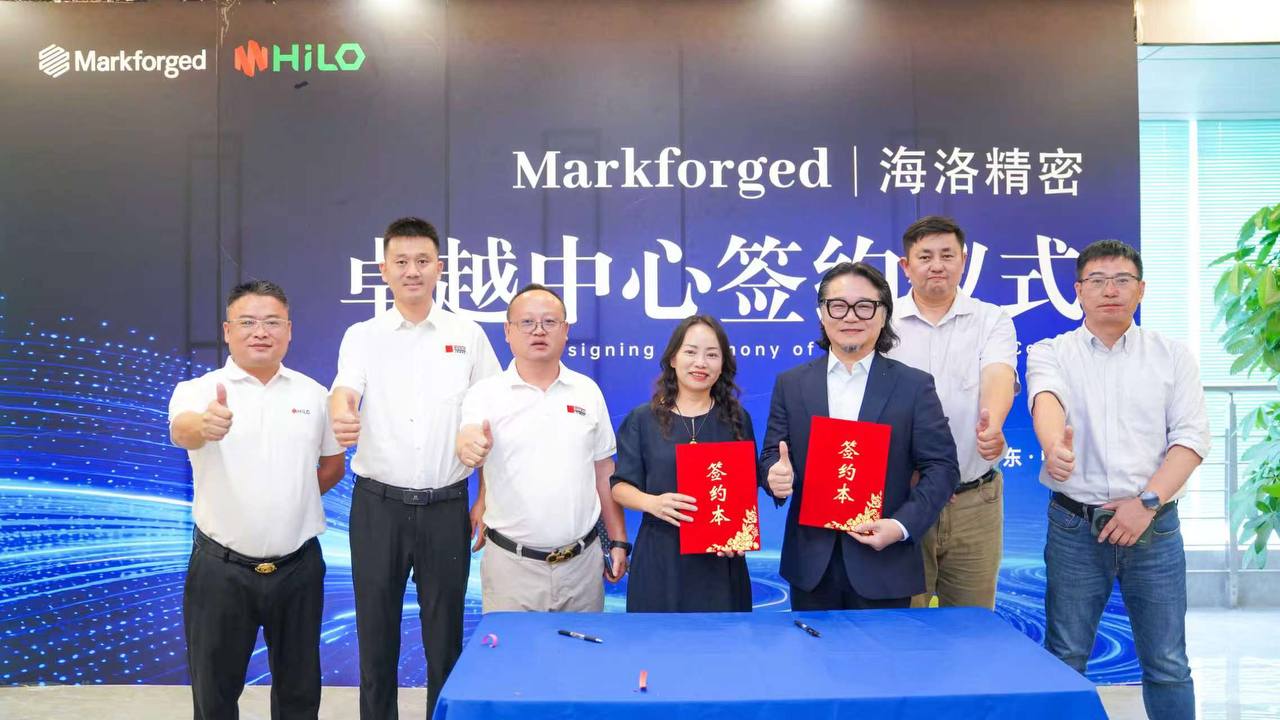
Markforged and HiLO sign South China Center of Excellence
HiLO was established by Mr. Xiang Lingyun of JSWAY CNC as a dedicated company for the Markforged business. JSWAY CNC has built its position in Swiss-type lathes, turn-mill machines and thermal-compensation intelligent CNC lathes, with a manufacturing base in Banfu, Zhongshan. Taking on additive manufacturing through a separate company signals that this is not an add-on to the existing machine-tool business, but a line expected to grow on its own.
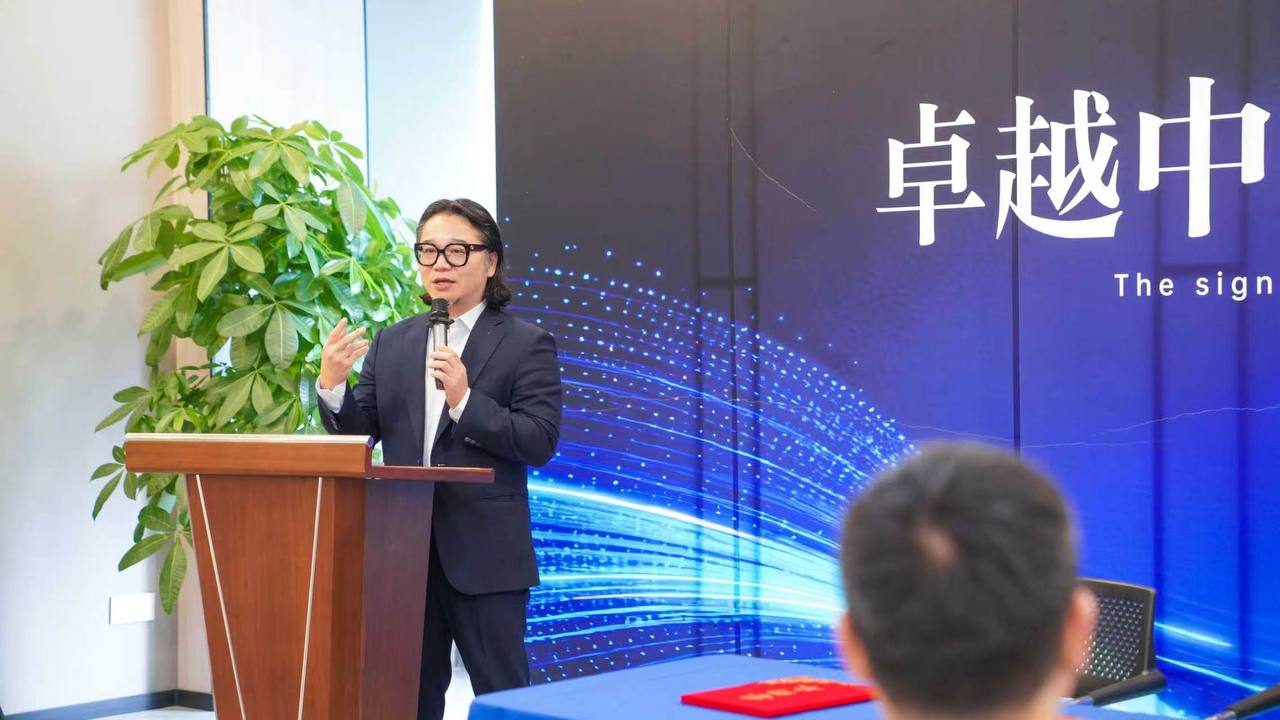
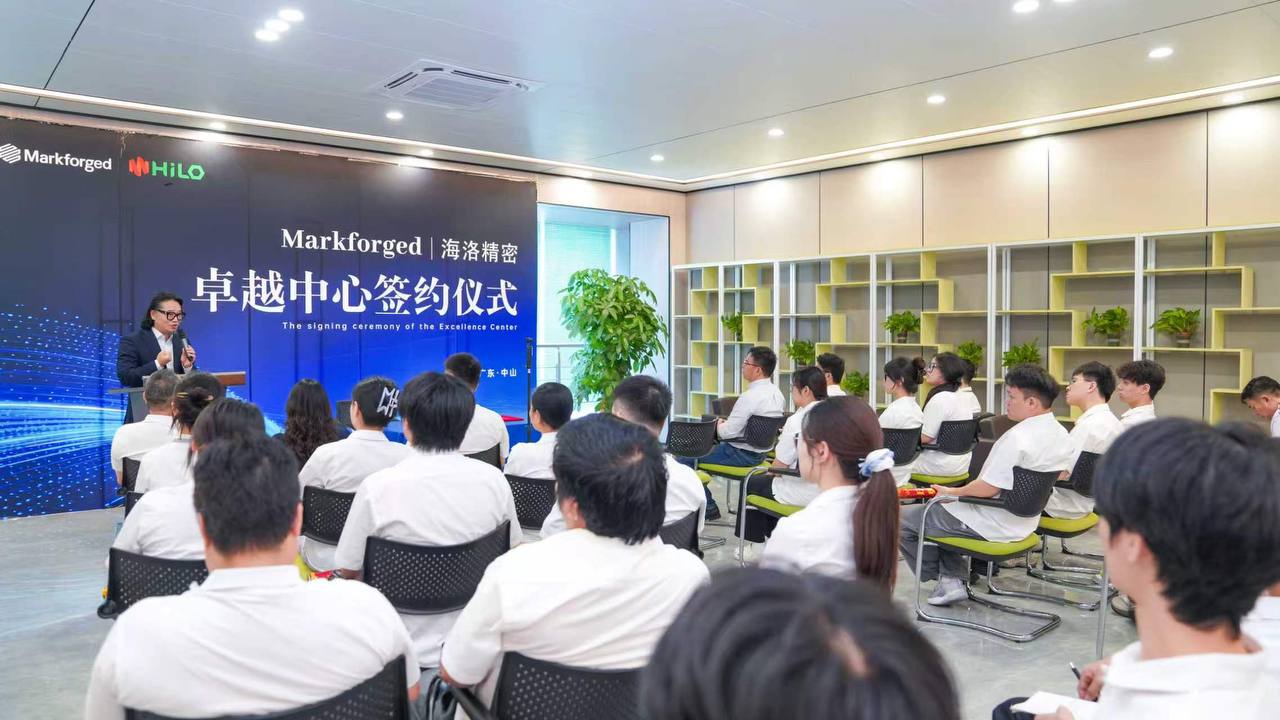
All three speeches returned to the same point: the Center of Excellence is not a showroom.
Equipment can be bought and materials can be bought, but a team that knows which fibre path to use and how to design for the process cannot be bought.
HiLO R&D Director · signing ceremony remarks
Positioning
Not a showroom, but an industrial incubation platform
HiLO General Manager Zhang Yu set the tone in his remarks: the centre is not just a technology showcase, it is an innovation incubation platform for industry. Additive manufacturing, he said, breaks the design constraints of conventional machining and opens a new path for lightweighting, complex geometry and rapid product iteration, making it foundational technology for innovation in advanced equipment.
He set out a more ambitious goal: the partnership is not a simple import of equipment and technology but a deep integration of industry and ecosystem, with the centre intended to help redefine the Chinese benchmark for carbon fibre and metal filament 3D printing.
On talent, Zhang Yu gave as much weight as to capital equipment. People, he said, are the foundation of a technology company: every individual may be imperfect, but the organisation should strive for excellence. HiLO's stated ambition is to become one of the strongest 3D printing application companies in China and worldwide.
Technology
From can-be-made to worth-relying-on
HiLO's R&D Director opened with a market figure: the continuous carbon fibre 3D printing market is expected to reach USD 299 million globally this year, expanding at a compound annual growth rate of roughly 12 percent. He read that number as evidence of an industry judgement being validated — continuous fibre additive manufacturing is moving from something that can be made to something worth relying on.
On application sequencing, HiLO plans to enter through high-value, low-volume, highly customised fixtures and tooling, then extend into performance parts and formed parts, and ultimately into structural components for aerospace, automotive and robotics. He cited a public case in which continuous fibre printing produced the motor mounts and arm ends for a UAV with a 136 kg take-off weight, meeting demanding envelope constraints while reaching metal-grade strength.
The significance, in his view, is that engineers are no longer bound by whether a shape can be milled, or how long a part will take to deliver.
Team
Not teaching operation, but teaching judgement
The R&D Director spent most of his remarks not on equipment but on team building, laying out three levels. First, capability: fluent operation of the hardware and software. Second, judgement: understanding continuous fibre path logic, knowing which fibre orientation suits which condition, and where the limits of base material and carbon fibre interaction lie. Third, definition: working alongside customer teams to define the manufacturing approach from part function outward.
His conclusion: equipment can be bought and materials can be bought, but a team cannot — it has to be developed. The core of HiLO's approach is not teaching operation, but teaching judgement.
In his plan, what the centre shows visitors is not printing itself, but the complete path a part takes from requirement to delivery — something engineers who visit should be able to start doing the next day.
Integration
Integrating subtractive and additive, not replacing either
Brian Chen, Markforged Country Manager for Greater China and Vietnam, began by clearing up a common misconception: he is not there to replace subtractive manufacturing, not to replace CNC, and not to replace machine tools. The two sides are there to work together, and the integration of subtractive and additive is the better path.
On why this partner, he gave three reasons. First, the partner's leadership position and continued growth in Swiss-type lathes and turn-mill machines. Second, a shared philosophy: neither side competes on low price, and product quality should match its price. Third, execution — on each visit, he noted, the facility had moved on from the last: spaces already partitioned, progress that speed of decision alone cannot produce, because the whole team has to keep up.
For the centre, Brian Chen listed five objectives: a cross-industry application development platform, a professional manufacturing service platform, education and training, fixture and gauge development, and media and industry outreach. He noted that domestic 3D printing applications still have room to move up the value chain, with the larger market in advanced applications — robotics, unmanned systems and industrial fixtures and tooling.
He summarised the partnership in a sentence: what Markforged sells is not a 3D printer, it is a solution. More important than capital investment, he added, is the transfer of capability — the point is not to invest in equipment, but for the partner to genuinely master the technology.
Outlook
AI accelerates design iteration; additive turns it into hardware
On technology trends, Brian Chen framed the value of additive manufacturing as making AI physical: AI has sharply accelerated design iteration in the virtual world, and turning the virtual into the physical is where additive manufacturing earns its place. In his description, a customer imports a finished design directly into the platform and prints, sidestepping the trade-off between CNC scheduling and tooling lead time.
He offered one observation on industry density: at the Shanghai TCT exhibition in March 2026, exhibiting 3D printer manufacturers including desktop brands numbered more than 550. In that environment, technical differentiation and application depth become the dividing line.
Continuous fibre reinforcement is Markforged's patented technology. By laying continuous fibre into a polymer base material, printed parts exceed the strength of some metals while retaining the accuracy and surface quality required to go straight onto the line.
Next
Signing is only one action
Under the agreed plan, the centre will move on to facility build-out, education and training, market outreach and joint business development. Brian Chen closed by saying the memorandum is a beginning rather than an arrival, and that the next stage starts now.
HiLO's R&D Director ended on responsibility: signing is only one action; what matters is that from this day both sides carry it together — making continuous fibre printing not an advanced technology demonstration but a production tool manufacturing can depend on. From tooling to flight hardware, from one machine to one team, from one case to an industry habit.
Want to know whether continuous fibre tooling can go on your line?
Start with one thing: pick the fixture that eats the most lead time today, print it under NDA, validate clamping, rigidity and dimensions on the machine, and let the result decide the configuration.
Contact Markforged Greater ChinaSources and notes
- This article was written by Markforged Greater China from the signing ceremony held on 22 September 2026, based on on-site audio and photographs.
- Quotations are English translations of remarks delivered in Mandarin. Market figures and application cases were presented by HiLO's R&D Director and are not Markforged data.
- Photographs: 22 September 2026, Zhongshan, Guangdong.