
Greater China
Keep the Line
Running.
Key takeaways
- The three cases from August to October all involved electronics — chips, flight-control boards and cameras — and in every case the drones had already been delivered to the armed forces; one was caught only at the army’s acceptance teardown. Non-red checks will only tighten, qualifying sources will shrink, and any one supplier’s problem can stop a production line.
- 3D printing cannot make a chip. What it can bring in-house is the layer of airframe structures, fixtures and end-of-life spares: the parts that change most, are outsourced at shortest notice and have the least predictable lead times.
- Armed forces already remake discontinued parts on base and turn two-to-three-week resupply into hours; in Taiwan, the ASTER-SWARM airframe is revised, repaired and produced entirely at home. The first step is to walk the production line once and identify the parts worth bringing in.
None of the three military drone cases referred to prosecutors in Taiwan over the past two months were stopped by a document check: all three companies’ drones had already been delivered to the armed forces. The contracts banned parts made in mainland China, and one company had even supplied false certificates of origin; in the Taichung case, the army opened the airframes at acceptance as a precaution, found chips marked “CN” and referred the matter to prosecutors. For the industry, that means every part will now have to survive a teardown, and fewer sources will qualify. The fewer the sources, the more easily one supplier going end-of-life, slipping a delivery or losing its qualification can stop your line.
Chips depend on qualified suppliers.
Airframes, fixtures and spares can be made in your own plant.
NEWS · THE LAST TWO MONTHS
Three companies, three prosecutors’ offices, and every part in question was electronic
Between August and October, at least three companies came under investigation by prosecutors in Qiaotou, Taoyuan and Taichung for fitting mainland-made chips, flight-control boards or cameras into drones delivered to Taiwan’s armed forces. A founder and a general manager at two of the companies have been detained (United Daily News, 29 October). These are allegations under investigation and have not been ruled on by a court.
Policy has not softened. In January the Vice President said that government drone production and procurement, for the military and the public sector alike, must reach a 100% non-red supply chain (China Times). With budgets, orders and policy all moving forward, scrutiny will only tighten.
Purchasing and production feel it first. Every supplier and every part number has to come with proof, and any that cannot must be replaced; a new supplier means new quotes, a new origin check and a new place in someone else’s queue, and the line waits in the meantime. So these cases raise a second question beyond compliance: when an outside source fails, which parts can you make in your own plant?
BOUNDARY · WHAT IT CANNOT DO
A drone has three layers of parts, and 3D printing can take on two of them
Start with the limits. The chips, flight-control boards and cameras at the centre of these cases cannot be 3D printed; resilience in the electronics layer comes from qualified suppliers, origin traceability and safety stock. Industrial 3D printing can take on the other two layers.
What the structural and production layers share is low volume, frequent change and urgent lead times. A longer arm, a different motor or a part going end-of-life means structures and fixtures have to change too; outsourced machining means new stock and a new slot in the schedule, and the wait is often longer than the design work itself.
At an executive roundtable during Land Forces 2026 in Australia this October, Markforged’s Vice President for Asia Pacific, Richard Elving, was measured about the scope: additive cannot print a whole platform; its place is in sustainment, producing critical components and temporary replacement parts, and for the manufacturers in the room it might cover one to five per cent of what they make (Markforged media hub report). The share is small, but when a line stops, these are often the parts it is waiting for.
SUSTAINMENT · DISCONTINUED AND DELAYED PARTS
Discontinued parts remade on base, and two-to-three-week resupply cut to hours
When a source fails, it usually fails in one of two ways. In the first, a part goes out of production and the original maker stops supplying it, so someone has to find a new supplier to tool or machine it. A US Army training base faced exactly this: a hatch plug on one of its vehicles was discontinued, and reproducing it would have cost about US$10,000 with a three-month lead time. The base printed it on site on Markforged printers in Onyx composite for about US$230, and cut the design from ten parts to four (Markforged case study).
In the second, the part exists but sits at the far end of a supply line. During the US–Korea CJLOTS 26 exercise, Marines reverse-engineered and printed a boat strainer in under half a day inside an X-FAB expeditionary shelter equipped with Markforged Mark Two printers, turning a two-to-three-week resupply into a few hours (DVIDS).
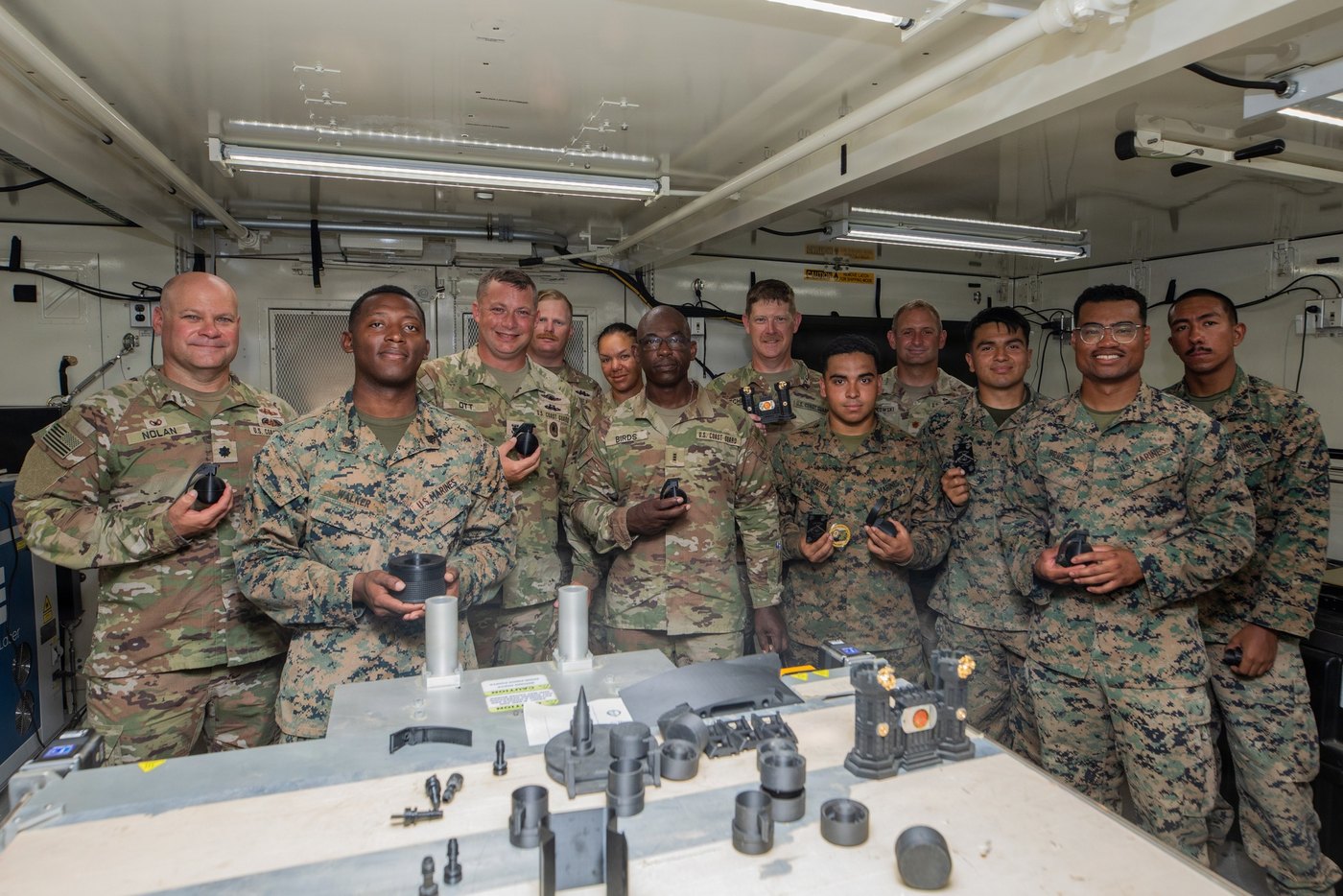
Both situations were solved the same way: the part’s source moved from an outside supplier to a qualified machine on site, a design file and a recorded lot of material. For a maker that has to stay non-red, that is also one fewer outside part number to trace.
REVISION · SPEED OF CHANGE
Overseas buyers want revisions faster than outsourced machining can deliver
Export markets care about something else. Czechia became the largest market for Taiwanese drones in the first quarter, yet CzechInvest says European procurement still treats non-red as a preference rather than a rule; on the Ukrainian front line, buyers still look at volume, price and lead time (TechNews). The same report quotes a Ukrainian National Guard liaison officer with one example:
A revision moves only as fast as its slowest part. If structures and fixtures depend on outside machining, every change joins the queue again; printed in-house, a revised design can become a part the same day. The armed forces want a drone that is still non-red a year and three revisions later, and overseas buyers want revisions that keep pace with the battlefield. Both need qualified parts soon after every revision.
CASE · AN EXAMPLE FROM TAIWAN
ASTER-SWARM: an FPV airframe that no longer depends on imported carbon plate
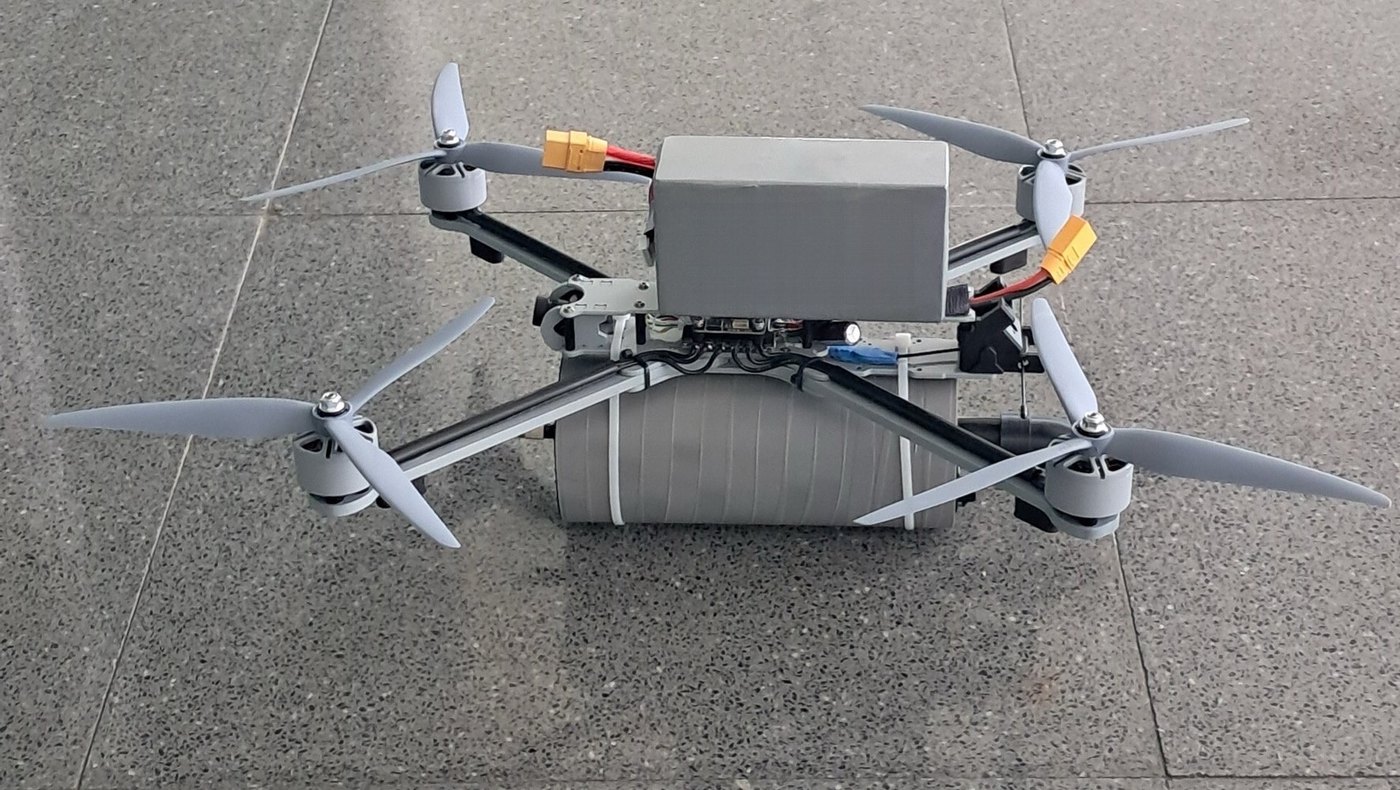
ASTER Technology’s ASTER-SWARM is a single-use FPV strike drone. An FPV airframe has to survive full-throttle acceleration, hard turns and dives within seconds, and frames printed in ordinary filament flex, resonate or even crack along the layer lines under that load. The usual alternative is a CNC-cut carbon-plate frame: strong enough, but dependent on imported carbon-fibre sheet and outside machining, with new stock and another wait for every design change (Markforged media hub case).
- Depends on imported carbon-fibre sheet
- Outside machining: new stock and a new wait for every change
- Too slow for prototype iteration, weak for a self-reliant supply chain
- Onyx shape with continuous carbon fibre along the load paths
- Five standard modules: a revision updates one module’s file
- Damage means reprinting one part, replaced on site
ASTER moved to printing every structural part of the airframe on a Markforged X7 Field Edition, with Onyx forming the shape and continuous carbon fibre laid along the load paths at the arm roots and motor mounts. The airframe is split into five standard modules — top plate, base frame, standoffs, front guard and payload interface — so damage means reprinting one part and a revision means updating one module’s file. Fitted with printed propeller guards, the same airframe becomes a trainer, and parts broken in training can be reprinted on site.
The prototype has completed take-off and high-speed flight tests and passed a Beaufort Force 9 wind test (mean wind speed 20.8–24.4 m/s), with the results measured and verified by a third party. Design, printing and assembly all take place in Taiwan, with no bought-in carbon-plate frames and no outside machining.
“An ordinary 3D-printed airframe shakes and cracks once it flies fast. With Markforged continuous carbon fiber printing, we could, for the first time, 3D print an airframe that truly holds up to high-speed flight. Add a modular design, and ASTER-SWARM can be revised, repaired and produced at scale entirely in Taiwan. That is exactly the capability self-reliant defense needs most.”
SECURITY · DESIGN DATA
Make the part on site, and keep the design file under your own control
Bringing parts in-house means planning data security at the same time: a leaked design file lets someone else make the same part. At Project Convergence 22, the British Army’s Royal Electrical and Mechanical Engineers (REME) received files for spares that US forces could not get through their own supply chains, printed them on site on mobile printers and handed the parts over; the only thing that crossed borders was the file (Mark3D video).
The files need protecting in transit too. Phase I of the US Army’s IBAS programme, worth US$7.5 million, is led by Automation Alley with NCDMM as prime contractor and Markforged and Fraunhofer USA as partners, and aims to prove that IP-protected manufacturing instructions can be streamed securely to distributed printers (PR Newswire).
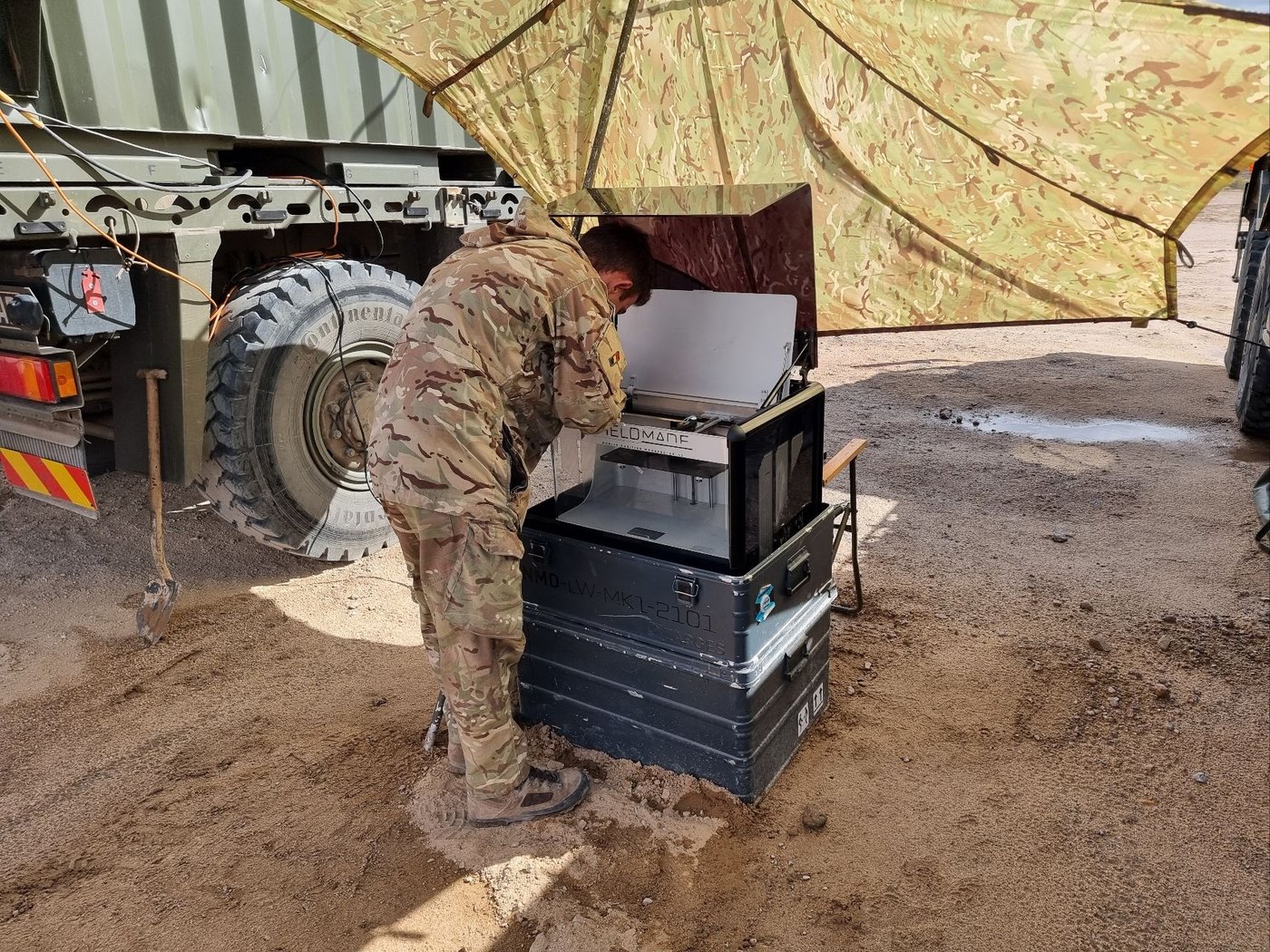
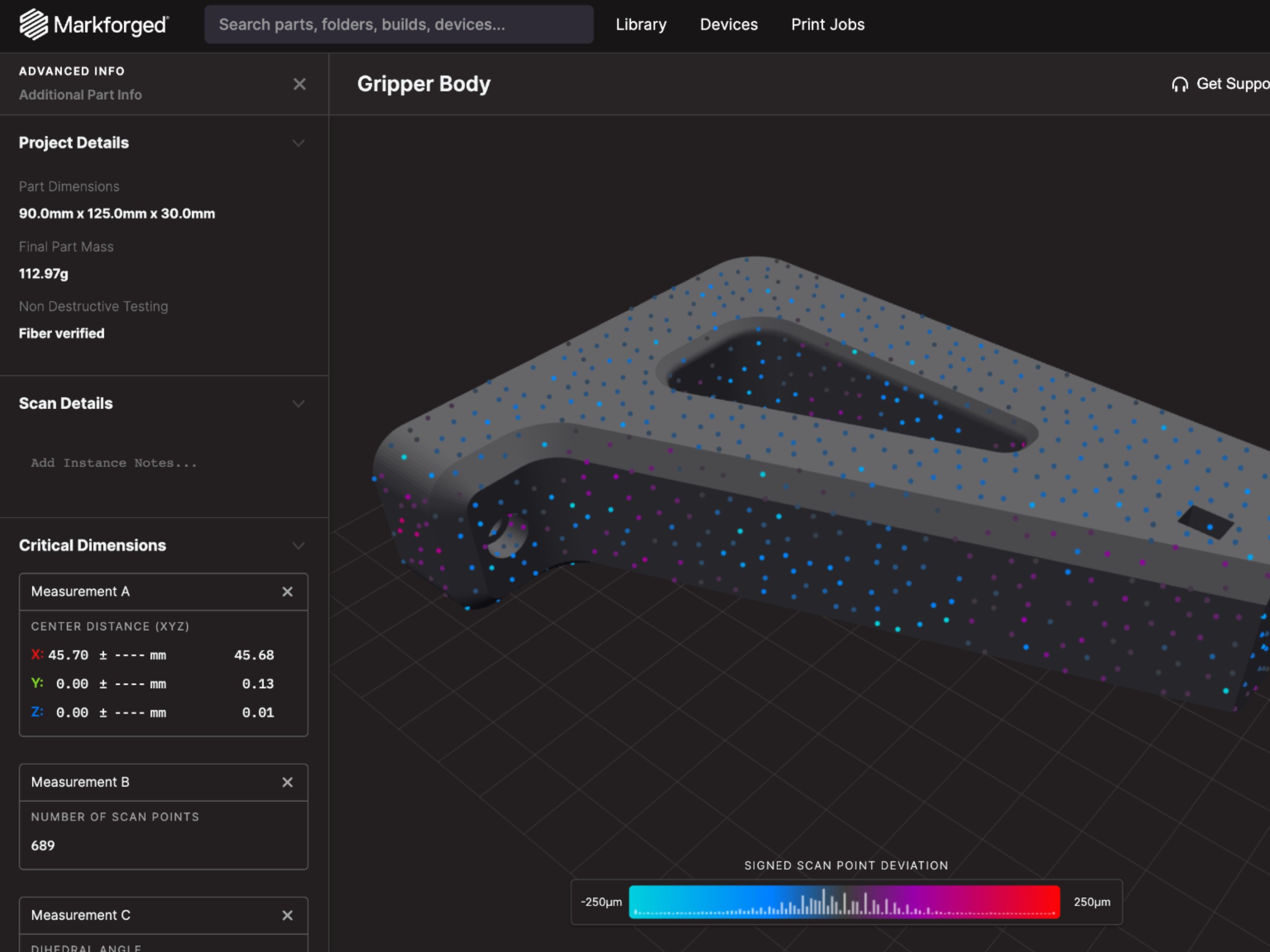
Inside a plant, access stays under the owner’s own control. Markforged holds ISO/IEC 27001:2022 certification (valid to December 2028) and CSA STAR Level 1; data is encrypted in transit and at rest, third parties carry out penetration testing and secure design reviews, and two-factor authentication and single sign-on are supported (ISO 27001 certificate, Markforged security).
FACTORY · THE FIRST STEP ON THE LINE
On the factory floor, the first batch is usually fixtures
Beyond the airframe, the production line has its own layer of parts that is easy to overlook. Drone makers and tier-1 suppliers change over often, and every changeover needs new fixtures, gauges and poka-yoke plates that compete with production parts for the same CNC time. After Yamaha Fine Technologies in Japan began making its production fixtures in-house on an X7, fixture lead time fell from about seven days to one, same day at best, and fixture cost fell to about 25% of what it had been; the X7 runs about 2,000 hours a year (Markforged customer case).
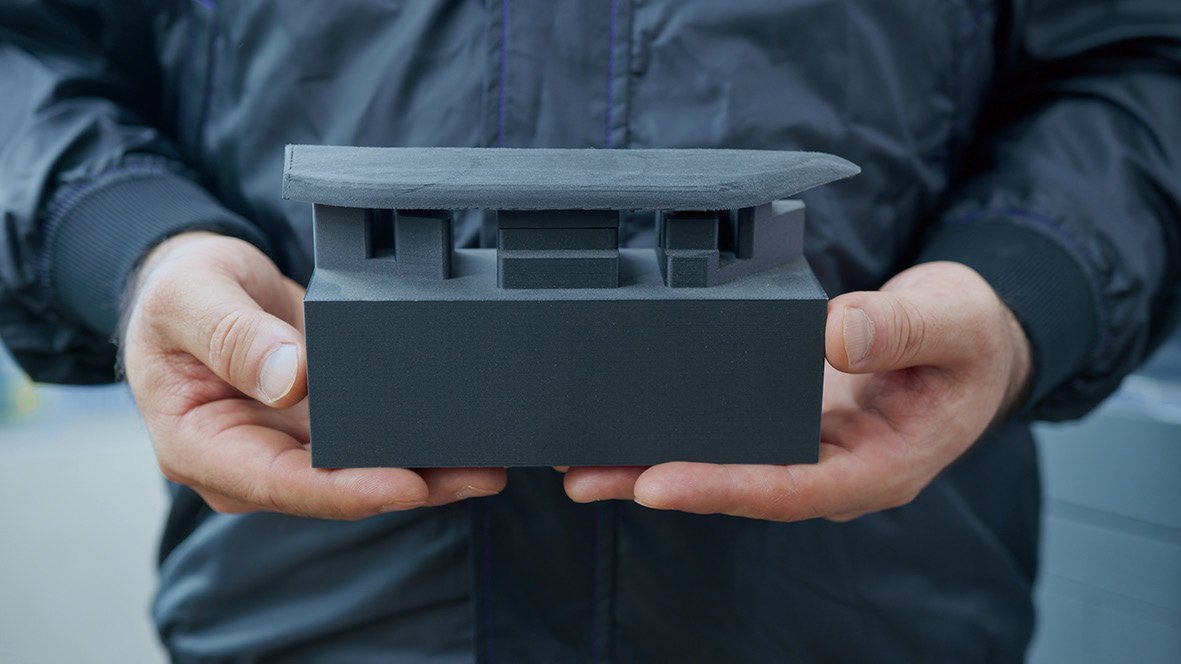
Fixtures never fly and never ship, so they carry the least risk and show results fastest, which makes them a sensible first batch. Once strength and dimensional data have built up, the same approach extends to structures and spares.
WHY MARKFORGED · THE EQUIPMENT ITSELF
Bring parts in-house, and the origin of the equipment and materials has to be clear
Once parts move from outside suppliers into the plant, what needs tracing shifts from a list of suppliers to the machines, software and materials on site. Markforged is a US company, and its equipment, software and materials are 100% non-red. Continuous carbon fibre has a tensile strength of 800 MPa, and parts reinforced with it can replace some machined aluminium parts and brackets, which gives discontinued metal brackets an in-house option too.
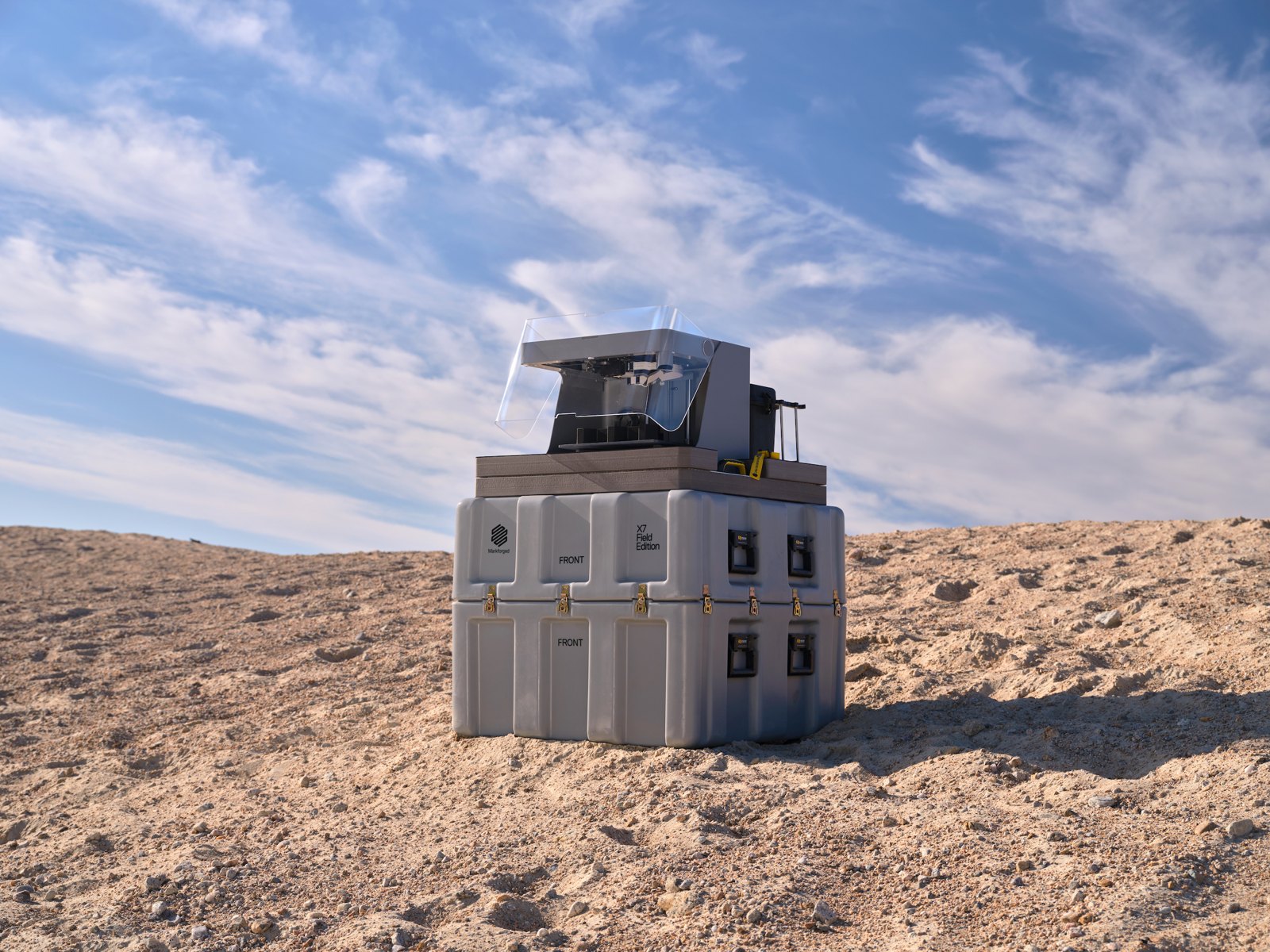
Drone makers and tier-1 suppliers with an existing factory use the production models — X7, FX10 and FX20. For exercise areas, forward bases and sites without a factory, there is the X7 Field Edition:
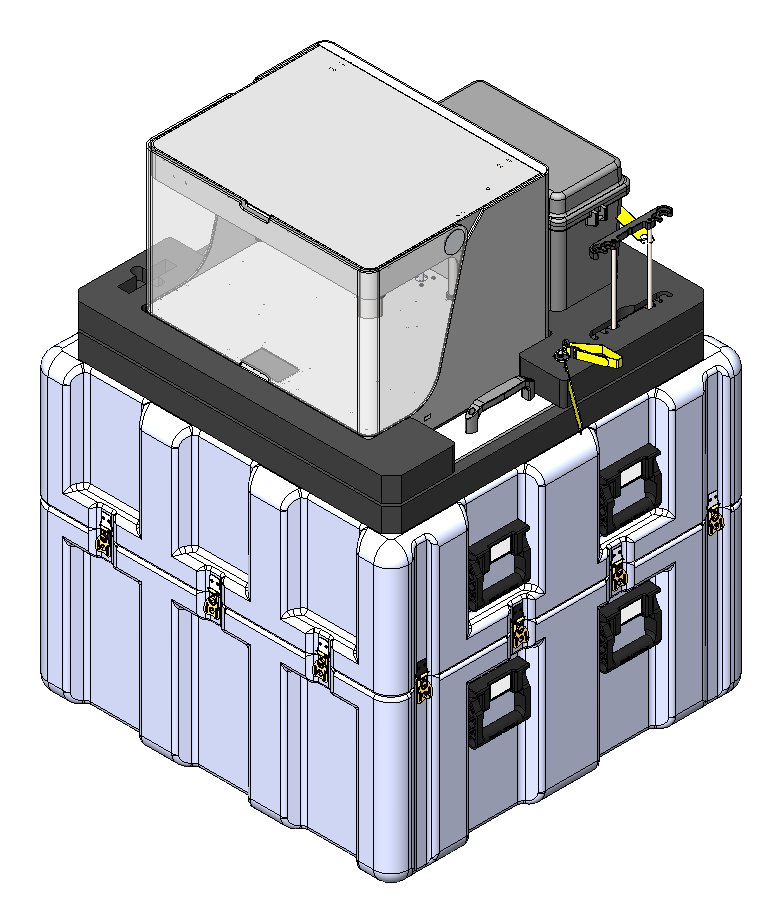
- Packed in a ruggedised Pelican transit case; a two-person carry, printing within three minutes of unpacking
- 150 W power draw; can run on a generator
- Included in US military MIL-STD-810 testing in support of a DoD Program of Record
- STIG-compliant operating system; a no-Wi-Fi version and offline software are available for secure sites
CONCLUSION · ONE THING TO DO NOW
List the ten parts that kept the line waiting longest last year
Pick one drone in service and list the ten parts that kept the line waiting longest over the past year. Mark each with its category, its outsourced lead time, how many times it was revised this year, whether the original maker still supplies it and whether its proof of origin is complete.
Leave the electronics to supply-chain management. Among structures, fixtures and spares, anything with an outsourced lead time measured in weeks, two or more revisions a year, no original maker left or incomplete proof of origin belongs in the first batch to bring in-house.
Book a Markforged walk-the-line visit
Markforged engineers will walk your line with your production, quality and design teams, pick out the parts worth printing in-house and work out the difference in cost, lead time and revision cycle. Fill in the site-review request below; when you submit, you will see which areas to review first.
- Walk the line: go through the structures, fixtures and spares that hold up production
- Sample prints: print two or three of your parts in continuous fibre and compare them on the line
- Business case: cost, lead time and revision cycle, outsourced versus printed in-house
- Offline deployment: equipment and software set-up when design files cannot leave the site
SELF-CHECK · BEFORE THE SITE REVIEW
Non-red drone production: resilience self-check
Twelve questions, about two minutes. When you submit, you will see which areas to review first on site and how urgent it is. We will contact you within three working days to arrange the walk-the-line visit.
- United Daily News (29 Oct 2026), in Chinese: non-red supply chain breached again by mainland chips in military drones
- China Times (28 Jan 2026), in Chinese: Vice President visits the Asia UAV AI Innovation Application R&D Center, Chiayi
- Commercial Times (15 Feb 2026), in Chinese: NT$44.2 billion for Taiwan’s drone industry
- TechNews (24 Oct 2026), in Chinese: “non-red” is only a bonus for Taiwan’s drone makers
- Markforged media hub (7 Oct 2026): Land Forces 2026 defence manufacturing executive roundtable
- Markforged case study: United States Army
- DVIDS (US Department of Defense): Advanced manufacturing supports joint and bilateral readiness at CJLOTS 26, South Korea
- Markforged media hub case: ASTER Technology ASTER-SWARM
- Mark3D video: British Army is utilizing Markforged
- PR Newswire: Automation Alley awarded contract to advance secure distributed additive manufacturing
- Markforged customer case: Sophisticated Production Systems With Yamaha Fine Technologies
- Markforged ISO/IEC 27001:2022 certificate
- Markforged security overview
- Markforged product page: X7 Field Edition