
News & Insights
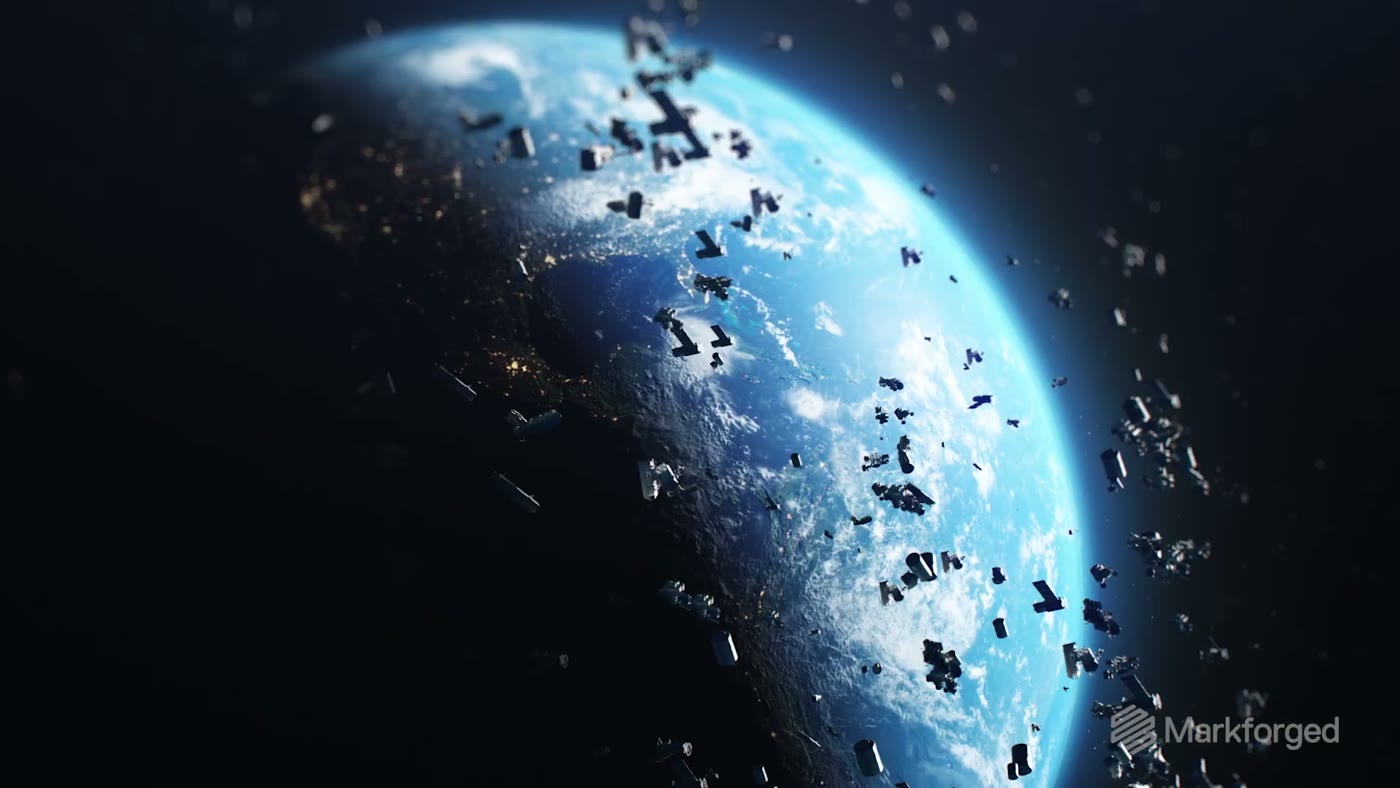
US satellite manufacturer Sidus Space has a concrete answer: print the entire structure in continuous carbon fiber and Onyx. And it is not an experiment — LizzieSat-1, -2 and -3 are already operating in low Earth orbit.
“I don't think we would be doing this if it wasn't for Markforged, honestly.”
Carol Craig | Founder and CEO, Sidus Space
Why satellite structures are hard
The whole satellite must stay under 100 kg — and every gram out of the structure is a gram of payload in
The mass budget is hard-capped. Batteries, computers and the rest of the bus already consume most of it, leaving very little for structure. Sidus Space's design engineer explains in the film that their approach is not only to make parts lighter but to change the structure itself — every gram taken out becomes a gram of payload.
And neither launch nor orbit is forgiving: 5 g of load at launch, then solar radiation and severe temperature swings between the sunlit and shadowed sides.
The evidence came first
A year outside the ISS — and the parts came back indistinguishable from new
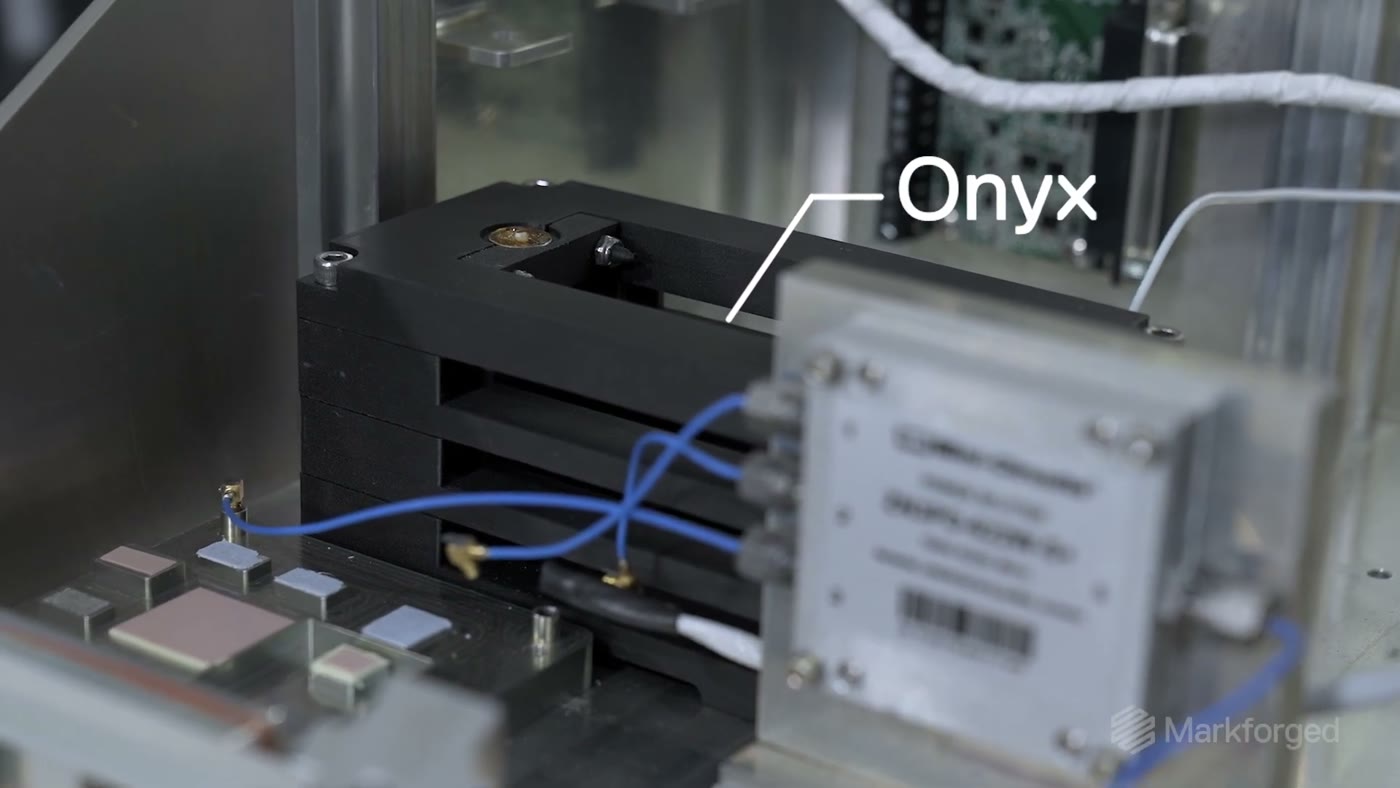
Before LizzieSat, Sidus Space built a flight test platform: sample holders rapid-prototyped in Onyx, flown on a materials exposure experiment to the ISS, then brought back down and inspected.
The exposure was planned for about 15 weeks; it ran a full year. White control parts in the same batch degraded visibly under the sun. The Onyx parts showed no degradation at all.
Tony Boschi, Sidus Space's Lead Design Checker, describes what came back: “There's no difference between a part that's just come off the machine and what's been out in space for a year.”
That result is why LizzieSat uses Markforged as its structural base. The order matters: flight evidence first, satellite second.
Why printing, not machining
Some geometry cannot be machined — and a design change turns into parts the next day
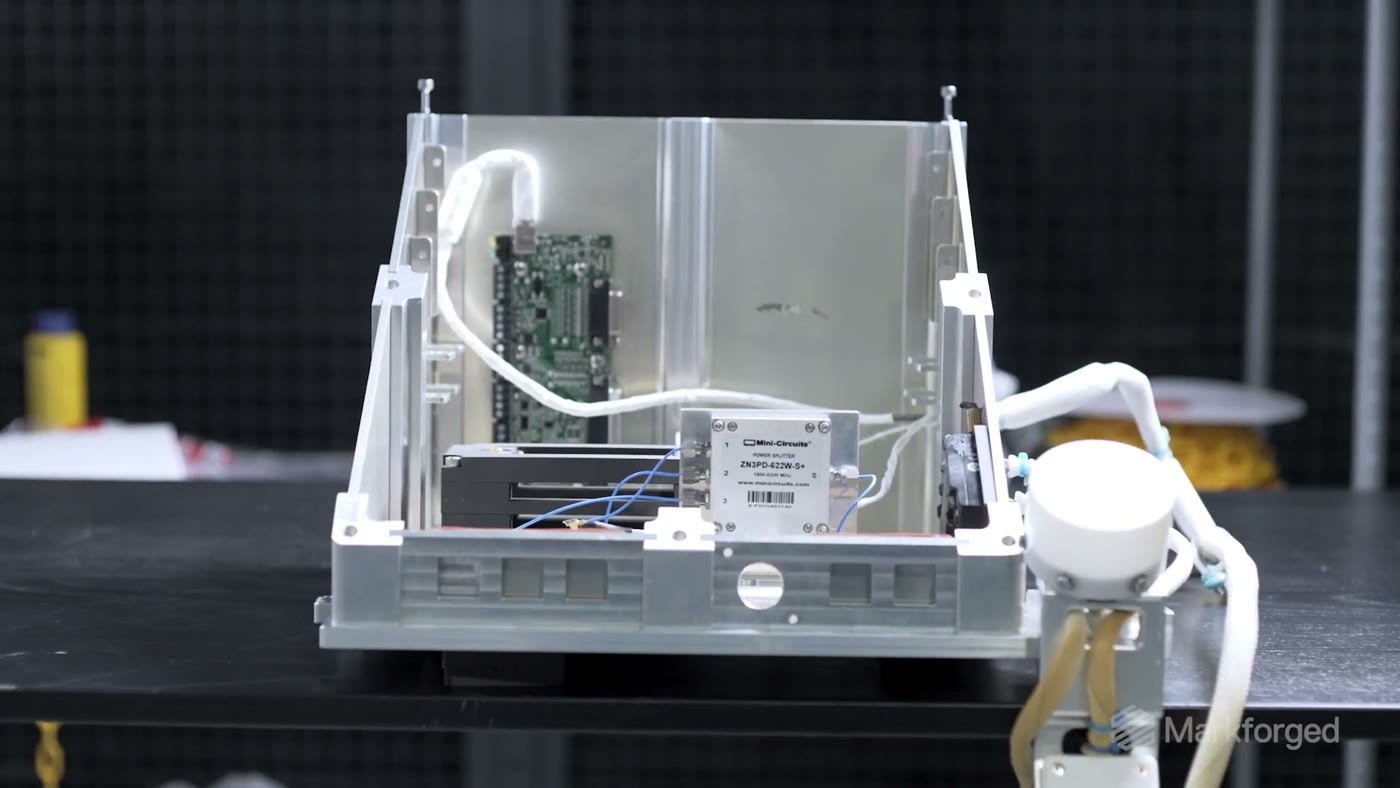
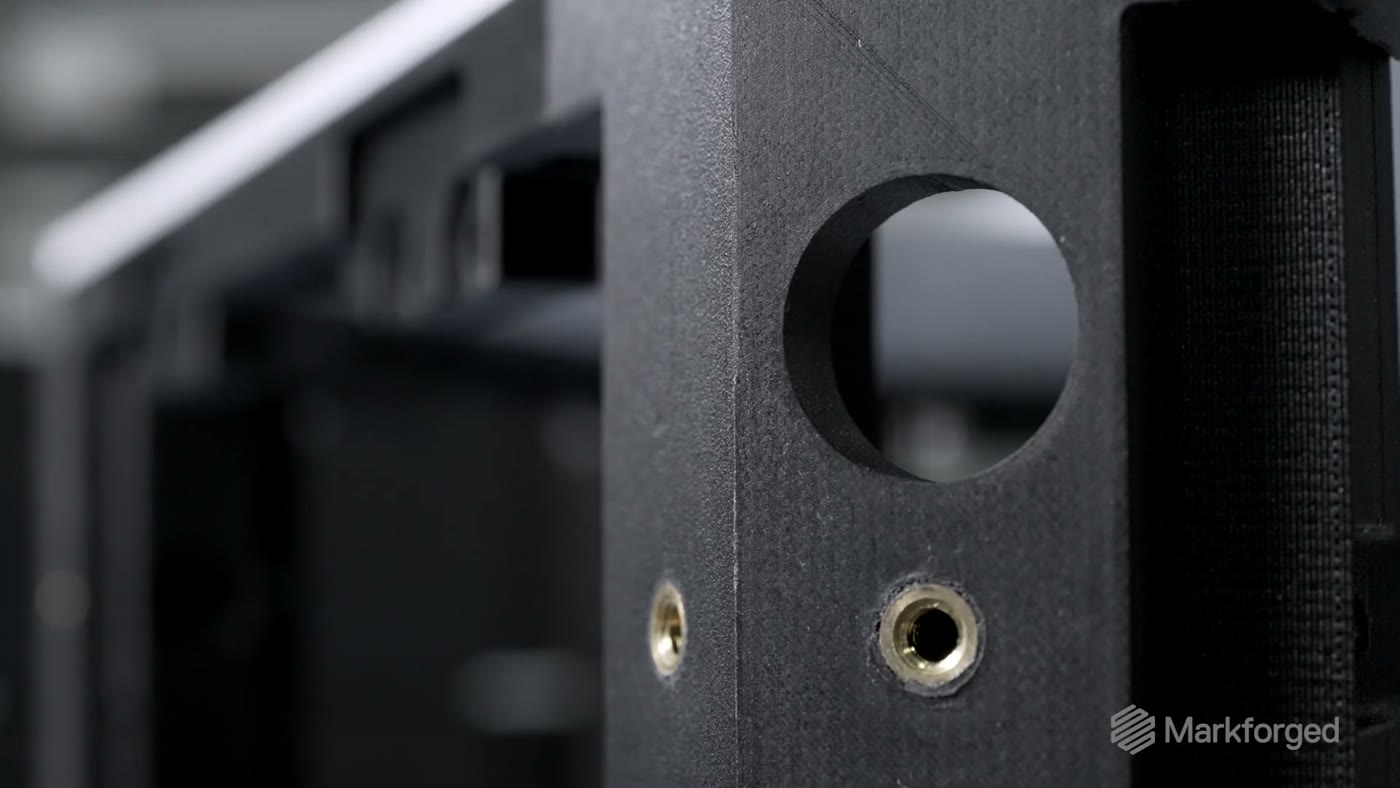
To take the weight of screws out of the assembly, Sidus Space designed the fastening feature into the structure itself: the part drops into a slot, locks in place, and cannot be pulled apart afterwards. As explained in the film, one end of that feature could be machined — the other end could never be — and the printed parts hit the required tolerance every time.
Speed is the second reason. In aluminium, one design change has to pass through redesign, machining and assembly. Printed, the change is reprinted the same day and there are brand-new parts the next.
Material traceability
Aerospace and defence buyers need more than strength — they need to trace the material back
Sidus Space now prints with Onyx FR, a fire retardant material, and also uses Onyx FR-A. The A designation carries full material traceability — stated plainly in the film as a hard requirement at many companies. If a crack or shear appears where the analysis said it should not, the material's production history can be traced back, the cause found and corrected.
Worth noting alongside this: Onyx FR-A and Carbon Fiber FR-A are NCAMP qualified on the Markforged X7, which gives manufacturers working through aerospace qualification an existing path.
Bring this path into your programme
For LEO satellites, UAVs or any structure under hard mass and environmental constraints, we can walk your team through material selection, qualification paths and adoption.
Contact usSources
- Markforged official film, We 3D Printed a Satellite with Sidus Space. (published 2023). Both direct quotations in this article are verbatim from that film.
- In-orbit status and the upcoming launch are from Sidus Space investor announcements (verified September 2026): LizzieSat-1 in March 2024, LizzieSat-2 in December 2024 and LizzieSat-3 on 14 March 2025 aboard SpaceX Transporter-13 from Vandenberg; the next is manifested on SpaceX Transporter-18, no earlier than October 2026.
- The launch timing mentioned in the film reflects information at the time of publication and is superseded by the in-orbit status above.
- NCAMP qualification status for Onyx FR-A and Carbon Fiber FR-A is from Markforged material documentation.
- All images in this article are frames from the official Markforged film.
Back to the Media Hub · markforged.tw